(Let me first start by saying that I’m not advocating running a 12U practice without a practice plan. That is not advisable. This is a tale about how I accidentally ran a practice without a plan and how it worked out pretty nicely.
Last Thursday I arrived at practice thinking I was going to assist, not lead a group of 12’s and a few of their friends. I’ll clarify that I wasn’t assigned to be the assist, I was assigned to be the lead, but my head was full from a day of homeschooling and somehow I just missed the full scope of information (it happens).
Anyway, the assist coach and I spoke beforehand and agreed to some slightly planned out drills and skill work between the two of us and then I would lead the remainder of the practice including drill setup, demos and game play at the end.
We had a few new athletes that night, so there was a range of ability and skill. It was clear right away I would have to adjust and tweak things as we went along but that’s normal for any practice, coaches are used to knowing when to progress or regress a drill at any given time based on the needs of the group or individual athletes or if something isn’t working all together.
Once the practice started, I felt the familiar tension of managing a group with different needs and abilities. The tension that makes you want to cater to the more advanced athletes and be frustrated with the ones who are just learning. Or the tension that makes you want to tell the more advanced athletes that we need all the skills, not just the skills that are fun.
The tension of the parents watching on the sidelines who might be thinking “what the heck is this coach doing?” I’m not saying this tension is necessarily true, only that it exists for me.
As I navigated this familiar tension, I remembered a coaches clinic I attended last summer; The Way of Champions Conference and one of the speakers, Dr. Jerry Lynch who had a unique and special way to beginning each of his sessions.
Jerry began each of his coaching sessions at the back of the room. An extremely passionate coach, mentor and teacher, Dr. Lynch is also an intuitive sports psychologist – so, he’s not just standing at the back of the room waiting for his turn to speak, he’s reading the room. He’s measuring and taking in the full energy of the group.
When it was his time to speak, he had all of us coaches come into a small huddle. All 100(ish) of us, in a small shoulder to shoulder huddle. Once we are shoulder to shoulder, he tells us to come in even closer. And then, once we are closer, he says to come in closer, yet again. By day three we know the drill and we just start all up in each other’s business to save time. (It’s summer 2019, pre-pandemic and nobody was thinking how much coaching would change and how huddles, high fives and respiratory droplets would be a thing of concern).
Once we are in the huddle, Jerry begins with a story. The whole time he’s still reading us, reading our responses to his story, to each other, to being a little bitty huddle with people who are no longer strangers. He’s also measuring his own energy and responses; after all, his own responses to us are also a mirror of the group. It’s an emotional, spiritual and physical circle few of us are aware of in that moment.
What he says in the huddle slips my mind. I recall a few details of a story he told us about his son texting him or a some details of a team he’s working with, but really what I remember is his ability to just vibe-out every single one of his sessions and how connected I felt.
No script, no slides – all vibes (make a sticker of that).
And so there I was last Thursday in the middle of a practice I forgot to plan just vibing-out the room (or the court). Watching when a drill became too stale and kids started tuning out. Looking at the connections between the girls and gauging if they were having fun, complaining, talking badly about themselves. Keeping an eye on my assist to see if he was confused (perhaps, at times) or if he was connecting with his group (he was).
As coaches, we usually see that kind of stuff from an analytical point of view and we are good at adjusting and adapting on the fly, but at this practice I felt different. I wasn’t analyzing. I was vibing (make another sticker). No, I WAS JERRY LYNCHing my practice.
At one point I remember hearing a new athlete almost scream the words “this is so much fun!” Her excitement bursting from her chest. The tension from earlier in the practice had faded completely. From me and the athletes.
Like I said, I’m not advocating running practice without a practice plan. In fact, I make sure to have a plan for the sole purpose of being engaged and in the moment – lack of preparation can create tension too – but it was kind of cool to see it with the wheels completely off.
I like structure and kids need structure too, but maybe every once in a while we Jerry Lynch a practice and see what happens. Maybe sometimes we ditch the slides and scripts and vibe our way through.
Priscilla Tallman is a freelance writer in Phoenix, AZ. She has an undergraduate degree in Psychology and graduate degree in Clinical Psychology. She has written for FloVolleyball, Volleyball Magazine, The Art of Coaching Volleyball, Sweat RX, Gorgo Fitness Magazine, CrossFit Fury, The CrossFit Games and OPEX Fitness. She written two performance journals
She is an 2x All-America volleyball player from the University of Georgia, SEC Freshman and Player of the year and was inducted into UGA’s prestigious Circle of Honor in 2006. She has played on the US National Team and enjoyed a bit of professional ball in Europe and on the beach. She has coached at the youth, high school, club and collegiate level. She is married with two children and currently coaches performance and mindset journaling to youth and college athletes and coaches.
Brent Brennan is the Head Football Coach at San Jose State. He’s in charge of over 100 young men and oversees a staff of over 20. His team only recently returned to campus in limited capacity, but Brennan says it’s still messy and complicated.
In the wake of a pandemic that shut down sports on a global level, a social justice movement that has given public voice and platforms to current and former athletes and an election right around the corner, coaches are guiding young athletes in more than systems, scouting reports and building team culture. Athletes and coaches are navigating new waters with heavy emotional and mental consequences.
The Numbers From the beginning of the pandemic to now, mental health statistics on depression and anxiety are way up in populations and demographics across the board – as of May 2020, anxiety screenings on mhascreening.org have increased by 370% over January. Prior to Covid-19, nearly 1 in 5 reported symptoms of anxiety or depressive disorder and during the pandemic that number increased to more than 1 in 3. Perhaps most alarmingly, 21,000 people considered self-harm or suicide in the month of May alone (see Kaiser Family Foundation article titled “The Implications of Covid-19 for Mental Health and Substance Abuse” for additional information, statistics and research specific to the pandemic).
Clear numbers for student-athlete populations are yet to be determined, but here’s what we know: social isolation, loneliness, disruption of daily routines and not engaging in person with peers and teammates are all contributors to the increase in reports of mental health in youth populations who have been removed from school and/or sports programs.
“The pandemic has either revealed mental health issues that were previously unknown or created mental illnesses that was not there before. What we are seeing is an increase in anxiety and excessive worry,” said Joe Jardine, a Marriage and Family Therapist who teaches a university level psychology class and treats clients throughout Orange County, California.
Jardine is also a performance coach for professional (NFL, MLB) and collegiate (NCAA, PAC-12) athletes, teams and coaches and has noticed some trends since the pandemic started early this year,
“People are feeling helpless because they can’t do anything about it and they are feeling hopeless because there is no end in sight. When helpless and hopeless meet, that’s where we have mental health problems,”.
Joe Jardine, MFT
The Athletes Samantha Arellano is going into her junior season as a collegiate volleyball player. When quarantine hit, her coach did what many coaches did at the time – made sure to connect with and provide as much structure to her team as possible. Skill workouts as well as strength and conditioning workouts were provided and adjusted for each athlete depending on what equipment was available to them in their homes. The structure was nice, but without teammates, motivation wasn’t as easy to find.
Arellano, who has suffered from social anxiety and depression even before her sports career said “quarantine brought on a lot of mental challenges. I hit a low point during the quarantine when I felt like I couldn’t do it on my own. But I had to learn to struggle on my own, with no one two feet away from me saying “Samantha, you can do this.”
Another collegiate volleyball player, who wished to remain anonymous, found similar struggles. While her coaches and teammates connected via weekly zoom calls and continued their group chats, the lack of physical connection or gathering began to take it’s toll. As an athlete who rehabbed through several injuries to train for Spring season, news of the cancellation was difficult.
“I was finally getting healthy and to have that removed again, it was a gut punch,” she said.
Current Volleyball Athlete, NCAA, Division I
As important as rehabbing her physical injuries, she has a mental health history of PTSD (discovered through athlete counseling a few years earlier) that requires her to recognize triggers and lean on her support system to stay healthy.
“In terms of health and mental health, it was amazing. My therapist was reachable by phone and I can still see her by FaceTime if I need to,” she said. Like Arellano, she found difficulty and struggle early on, but also found meaning and purpose in that struggle. While most athletes know how to solve problems on the court and in the weight room where things are assigned and controllable to an extent, life off the court doesn’t have the same rules.
“Quarantine allowed me to cope with things better, but at the same time it forced me to push the limits of my frustration. I found I could solve issues off the court too. By pushing myself, it made me more confident. I found my own voice off the court,” she said.
So, What’s Working? While most athletes and students are back on campus, some in limited capacity, it’s still complicated. Training in some conferences is just that, training. There’s no short term goal or long term answers being provided and no competitions to be played. Athletic programs are learning new information every day and every week. The structure they do have comes in the form of practice and school.
But without consistent face to face access to athletes, it’s hard to identify what their actual needs are.
“Some of the young people I’m working with, they don’t have a healthy home environment. That space is really complicated for some,” says Brent Brennan.
Brent brennan, Head football coach, San Jose state university
Despite limited physical connection between coaching staff and teammates, one thing Brennan has added in recent years – and continued weekly throughout quarantine and returning to school – is the addition of a sports psychologist and the Headspace app. This not only helps improve their game, it leads to better mental health and equips them with tools they need for sport and life.
So, what’s working? What can we learn from collegiate programs, coaches and athletes?
Connect. * Check in with your athletes, regularly. * Know your mental health resources and how to refer your athletes. * Ask hard questions. Not just about sports, but about their lives. * Determine what stressors to take on and which ones to refer out. * Enlist as many supportive people as you can for athletes and staff. * Coaches need to stay healthy too. Get rest when you can. * Have your sports psych do a coaches meeting to give your staff healthy resources too.
And those video conferencing calls? Keep them going.
“It is some connection. It’s not the connection we crave, but it’s still connection,” said Brennan.
Priscilla Tallman is a freelance writer in Phoenix, AZ. She has an undergraduate degree in Psychology and graduate degree in Clinical Psychology. She has written for FloVolleyball, Volleyball Magazine, The Art of Coaching Volleyball, Sweat RX, Gorgo Fitness Magazine, CrossFit Fury, The CrossFit Games and OPEX Fitness. She written two performance journals
She is an 2x All-America volleyball player from the University of Georgia, SEC Freshman and Player of the year and was inducted into UGA’s prestigious Circle of Honor in 2006. She has played on the US National Team and enjoyed a bit of professional ball in Europe and on the beach. She has coached at the youth, high school, club and collegiate level. She is married with two children and currently coaches performance and mindset journaling to youth and college athletes and coaches.
When quarantine began, many athletes found themselves sidelined. Not because of an injury, but because the world hit the pause button. I coach for a beach volleyball club and we had been discussing the roll out of a mental training/mindset/performance program for some of our select athletes. When our sports were put on hold, we decided to fast track the program and use this as an opportunity to fine tune the mental aspect of our game since our physical and competition reps were limited.
A group call each week presented the information and work for the week and an individual call where we talked about their personal goals, dynamics and looked at the specific mindset tools each athlete could use to improve their individual game within a team context. The individual work pushed them to see their limitations, how their mindset is currently helping or hindering their performance and which tools worked best for them and which ones didn’t.
I started to see patterns and similarities between athletes and I want to share my findings here in hopes it can help more athletes, coaches and parents.
PREPARATION IS KEY – Every athlete knows how to prepare themselves physically. If they don’t, they at least know what they should be doing to prepare physically. Nutrition, hydration, sleep, strength/conditioning training, speed work, getting their bag ready with everything they need for a competition and a good warm up were common answers athletes gave when asked them how they prepare to perform at a high level. Though these answers came easy, most of them couldn’t distinguish how to prepare mentally or emotionally for performance.
Mental prep includes things like visualization, performance journaling, gratitude, breath work and the ability to play and make decisions under pressure. Mental prep, however, is tied to both physical and emotional prep – so if you are physically prepped but not emotionally prepped, you’re only halfway there.
The key is having awareness of our emotions, and how they contribute to our performance. There is a time and a place for emotions: relationships, friendships, sharing with teammates and coaches off the court or being with family and friends. A rich emotional life is important to thrive and have a healthy life off the court. But what to do with them when we compete? Some athletes think that if we stuff them, shut them off or harden ourselves, we will perform better. That might work in the short term, but it isn’t sustainable. The answer? Awareness. Being aware of what you are feeling and when can be a quick way to prepare yourself mentally to compete.
Finally, understand your physiological response to stress. Start by figuring out where you feel stress in your body. Do you get butterflies before a big match, do you have to run to the bathroom or feel sick? Do your legs feel like a ton of bricks or do you get light headed or tunnel-vision? Your body gives you clues about your stress. Become aware of where you feel stress in your body, clear a path or use that stress to perform.
Physical Prep + Emotional Prep = Mental Prep
GOAL SETTING IS ABOUT SYSTEMS – We all know how to have goals or how to dream big, but for many athletes, it stops there. Cultural signals like “grind never stops,” “outwork the competition” or “character over talent” while motivating for some athletes, can be confusing to others and have you chasing the wrong things. In his book Atomic Habits, James Clear says “You do not rise to the level of your goals, you fall to the level of your systems.” Create good systems around the goals you are trying to achieve. You can desire a big, crazy goal (I encourage all athletes to write these down), but if you don’t have the habits or support to get there, your desire may lose out to discouragement, frustration, failure or many other obstacles in your way. You need something to keep you pursuing your goal in the face of adversity – environment, daily routine, friends you surround yourself with, what you spend your time on, what you watch, listen to or read all contribute to your system.
One more note about goal setting: Comparing your individual progress or your individual learning to another athlete will stop you in your tracks. Celebrate others, but keep your eyes on your own progress, you have your own goals.
COMMUNICATION WITH SELF/OTHERS – When asked about what they do to communicate, the most common answer athletes gave centered around strategy. What is the game plan, who do we need to watch, what did the scouting report say, what are a players tendencies, etc? While this type of communication is vital, team and individual communication are as important. It doesn’t have to be complex, but have a strategy for communication too. What hypes you up, what hypes up your teammates? Who needs to say more, who needs to say less? Who communicates strategic things? Encouraging things? Who challenges self and others when the game is tight? Anything works, the idea here is to talk about talking. One of the first things to go when a team is struggling is communication and it’s an easy skill to fix.
When asked about self-communication, the most common things athletes wanted to work on were “I want to be more positive,” “less negative” or “stop getting down on myself.” In order to have healthy self-communication, you have to practice it. Positivity isn’t free and you cannot reverse think yourself into being more positive. In fact, positivity may be the wrong rabbit to chase altogether. What most athletes are really looking for is confidence. Confidence can be built with positive self-talk and mantras (both mindset skills), but it is most commonly formed by trying, failing, learning and then trying again. Funny thing is when we gain confidence this way, we actually become more positive on the court.
Failing + Learning + Trying Again = Confidence –> Positivity
One more note on communication: Athletes who struggle with negative or toxic self-talk need lots of good learning reps without judgment of performance and a safe place to risk failure.
TAKING RESPONSIBILITY – When I am coaching a group who knows why they are there, it’s clear that work is going to happen. When you know why you train, why you show up, why you put in all the work you do to improve and be your best, you are taking responsibility of the outcome. While I love process and learning science, at the end of the day, sports is also about results. There’s a score and win/loss column and people depending on you to show up ready and prepared to compete. You don’t have to be obsessed with the outcome, but it needs to be on the radar – the previous three things lead to ownership and responsibility of your time:
preparation – physical, mental and emotional
goal setting/systems
communication with self/others
One last note on responsibility: Like any physical skill development, mindset is developed with practice and over time. Find what tools work for you and practice them. You might not see overnight results, but create a system and habits to practice them daily. When is a good time to journal or visualize without distraction? Will breath work help me in sports and before a big test/presentation? What friends or environments are a distraction to my progression?
Coaching sports and mindset are a great way to see what our kids and the next generation of athletes is about. I don’t have the luxury of saying “kids these days,” I need to be growing and learning along with them. Hearing them work through these big subjects and communicate openly and clearly to me has been an amazing way to spend quarantine. And, I’m thankful to be back on the sand coaching too.
Priscilla Tallman is a freelance writer in Phoenix, AZ. She has an undergraduate degree in Psychology and graduate degree in Clinical Psychology. She has written for FloVolleyball, Volleyball Magazine, The Art of Coaching Volleyball, Sweat RX, Gorgo Fitness Magazine, CrossFit Fury, The CrossFit Games and OPEX Fitness. She written two performance journals
She is an 2x All-America volleyball player from the University of Georgia, SEC Freshman and Player of the year and was inducted into UGA’s prestigious Circle of Honor in 2006. She has played on the US National Team and enjoyed a bit of professional ball in Europe and on the beach. She has coached at the youth, high school, club and collegiate level. She is married with two children and currently coaches performance and mindset journaling to youth and college athletes and coaches.
Actual footage of me waking up everyday and trying to live my life with seemingly never-ending chronic emotional, social and political unrest.
I mean there’s some kind of tension right now.
It’s not just me. You feel it right?
Tension at the grocery store standing on dots too far away from anyone to make small talk (something I relish in, I’ll admit).
Tension in my home as our conversations shift from this and that to conversations about what school will look like next year and how our summer will look much different this year than it has in the past.
Tension in my marriage as our conversations shift from coaching and sports to how we will take action and use our influence to impact our communities in a way that promotes fairness, equality and human rights for people of color.
Tension in my soul as I wrestle with my own experience with racism, my own silence about racism and my own guilt and shame about how little I’ve done on the topic – even though I am a second-generation Mexican-American who more often flew under the radar because of my light skin rather than spoke up for what was right.
What have I contributed because of ignorance, silence and shame surrounding my own experience with racism? The feelings I’ve stuffed over the years because people laughed at me or snickered because I was Mexican. How I’ve felt when people asked me “what are you?” (because my skin is light) in response to my Mexican maiden name versus what I look like.
See, this tension? This tension is layered. It is generational. It is currently fed by images in little square boxes and 280 character captions and people texting you articles to read, petitions to sign, ways to support, how to learn and so on and so forth as we try to peel the onion layers back and stack them neatly aside at the same time. I have almost 46 years of enneagram 5 layers. #iykyk
I was listening to a podcast (as an enneagram 5, my natural habitat is reading and podding – and apparently making up words too) and this tension is actually a thing. It’s not just something I feel, which is usually how things go with 5’s, this tension is real for all of us right now.
It goes like this: pandemic + quarantine + social unrest = this tension.
And, it’s happened before too.
More than once.
So, this tension? A socio-political emotional and economic math equation from our past.
Look, I am not trying to minimize this. I’m an enneagram 5. I actually understand it pretty well, five’s live their lives by their own set of formulas too, so if the world has a socio-political emotional and economic math equation, chances are you’ll find a five scratching their head, scribbling notes and then eventually finding a way to be useful, intentional and valuable in the midst.
5’s thrive on being useful and valuable. So when I’m not feeling it, you’ll find me journaling, writing or creating. It’s the 5’s defense mechanism to wasting away or riding off into the sunset without purpose. Or more accurately riding off to a quiet corner of the house to read and be with their thoughts.
So, this is where I am currently sitting. In a corner of my house, outside an equation, scratching my head, scribbling notes and looking to see where I fit. I won’t be here long because I am a person of action too. I don’t just fret and try to solve emotional and social equations, I do something about it.
I guess I’ll leave you with a list of five ways to make things better during this time of great tension. Atul Gawande, the author of “Better, A Surgeon’s Notes on Performance,” suggests five things to anyone who takes on risk and responsibility in society:
Find something new to try, something to change.
Count how often you succeed and how often you fail.
Write about it.
Ask people what they think.
Keep the conversation going (even if you have to speak up from that dot six feet away from the next patron).
In the last chapter of this book, Gawande says this “Arriving at meaningful solutions is an inevitably slow and difficult process. Nonetheless, what I saw was: better is possible. It does not take genius. It takes moral clarity. It takes ingenuity. And above all, it takes a willingness to try.”
The solution to the tension-creating equation above?
These five things. Start at one, move towards five, then start again. And, don’t forget these things take time.
Priscilla Tallman is a freelance writer in Phoenix, AZ. She has an undergraduate degree in Psychology and graduate degree in Clinical Psychology. She has written for FloVolleyball, Volleyball Magazine, The Art of Coaching Volleyball, Sweat RX, Gorgo Fitness Magazine, CrossFit Fury, The CrossFit Games and OPEX Fitness. She written two performance journals
She is an 2x All-America volleyball player from the University of Georgia, SEC Freshman and Player of the year and was inducted into UGA’s prestigious Circle of Honor in 2006. She has played on the US National Team and enjoyed a bit of professional ball in Europe and on the beach. She has coached at the youth, high school, club and collegiate level. She is married with two children and currently coaches performance and mindset journaling to youth and college athletes and coaches.
Not sure what terminology you used the past ten weeks in America – I realize the timing is different for different parts of the world as is the language used for what staying inside is – but regardless of jargon, for most of us, sports were pretty much shut down globally for some time.
In fact, professional and amateur athletes from around the world were encouraged to share their best “play inside” skills on social media. And, whether you are an athlete, a coach, a sports parent, referee, director of an athletic program or an admin booking hotels for sports teams – for all intents and purposes sports came to a complete stop and may never be the same again.
For better or for worse, when we return to play, it will be different.
But, I think there has been so many wonderful, and perhaps hard, things we learned about ourselves and our sports these past ten weeks. Here’s my top ten:
Athletes are creative, they’ll figure out how to play if they want to play – even if by themselves. So many creative ways to “play” the past ten weeks: skiing, figure skating, swimming with resistance in mini-pools, the April Ross Challenge for beach volleyball, it was so refreshing to watch kids be kids and have fun experimenting with their sport.
Not having a busy youth sports schedule created time for families to connect but it also created space and frustration for families who are used to moving at light speed. Either way, it gave us a chance to suss out our priorities if they were out of order.
For some, sport is the only emotional or safe outlet they have. There was an ache in many coaches hearts knowing “their kids” may not be in the safest situations. It has been said that coaches are second responders, we feel that ache for our athletes deeply. Up2Us Sports is providing mental health support through their coaches and working on ways to bring distanced coaching to the most underserved sports communities.
Some youth programs will not return or be canceled indefinitely after this. Their funding or their athletes ability to participate is no longer a financial reality for many families. There are many programs bridging this gap, but the reality is we will lose many amazing programs and athletes permanently.
Teams are teams are teams. Athletes, coaches and everyone in between worked hard to stay connected as much as they could. Again, there was so much creativity in how programs continued to educate, coach, promote and bring value to their athletes.
I think about the refs. Not the professional refs (sorry), but the community refs. Some of them referee’d games/matches in their retirement, as a second income, as a first job or as a way contribute to their families income. Some of them may not have been the quickest on the whistle or seen every call the parents saw, but there are some great people who loved their jobs, had a social outlet through their work and could earn some income as a ref.
When there was nowhere to play, no distractions of medals, podiums or win/loss records – some athletes chose to work on their minds.
There was loss for so many. Sports is an industry and this was an unexpected off-season for everyone. There will be repercussions – financially, emotionally, mentally and physically for many people. There will be necessary and permanent structural changes that have and may create a need for more education around mental wellness and mental health protocol.
The lessons from sports are there whether we are together or not. Learning from challenges, being cheered on by a teammate or member of you community, having a safe adult coach, listen to and push young athletes to try something new – we can do this in the context of sports or in other communities as well.
Thank goodness we had “The Last Dance” documentary. Without televised sports weekly or nightly, history gave us a gift.
Maybe you have some more things to add. I’d love to hear them. I know I don’t represent every demographic or every sport, but I love learning how sport impacts athletes, coaches and programs around the world.
Priscilla Tallman is a freelance writer in Phoenix, AZ. She has an undergraduate degree in Psychology and graduate degree in Clinical Psychology. She has written for FloVolleyball, Volleyball Magazine, The Art of Coaching Volleyball, Sweat RX, Gorgo Fitness Magazine, CrossFit Fury, The CrossFit Games and OPEX Fitness. She written two performance journals
She is an 2x All-America volleyball player from the University of Georgia, SEC Freshman and Player of the year and was inducted into UGA’s prestigious Circle of Honor in 2006. She has played on the US National Team and enjoyed a bit of professional ball in Europe and on the beach. She has coached at the youth, high school, club and collegiate level. She is married with two children and currently coaches performance and mindset journaling to youth and college athletes and coaches.
In early April, I was supposed to speak on a panel at a global sports summit with the Global Sport Institute on the topic of mental health and student athlete populations. The panel had a former wrestler from Arizona State University, Ryan Milhof, who had been public about his mental health struggles as well as Kristin Hoffner, a principal lecturer in the College of Health Solutions at Arizona State University. I was extremely honored to be in the room with these people. It was what I might have called a dream conversation. After all, I’ve been talking about mental health and athletes since I graduated from high school and more publicly on this blog for close to fifteen years – not that any of those things qualify me, but you can see why I’d be excited. (If you want to see my qualifications, you can skip to the bottom to read my author bio).
So why was this conversation so important? Let me back it up a little bit. In 2003 I started my graduate program in Clinical Psychology. In fact, on my mission statement at the beginning of that program, a hopefully 25 year-old me was certain I’d be set up on a college campus as a therapist and the athletes would just flock to me in droves.
Only problem was, athletes don’t need help.
I mean, we all know they need help, but they aren’t going wake up one day after years of being told to “grind harder” or “get tough” or “your fine, man up” to deal with their anxiety, stress, depression or any multiple other variations of mood or mental health issues. Nope, they are going to pretend like nothing is wrong, work harder, train longer, rest less, ignore multiple symptoms that usually originate physically, self-medicate, isolate and then one day an injury will stop them in their tracks or they’ll graduate or somewhere in between those two things, they’ll just break.
But why do coaches, admins, parents, AD’s and all staff have to wait for an athlete to break in order for us to provide resources? Where does sport culture start, how is it perpetuated and what is the answer to the panel conversation “Is Sport Culture Toxic to Athlete Mental Health?”
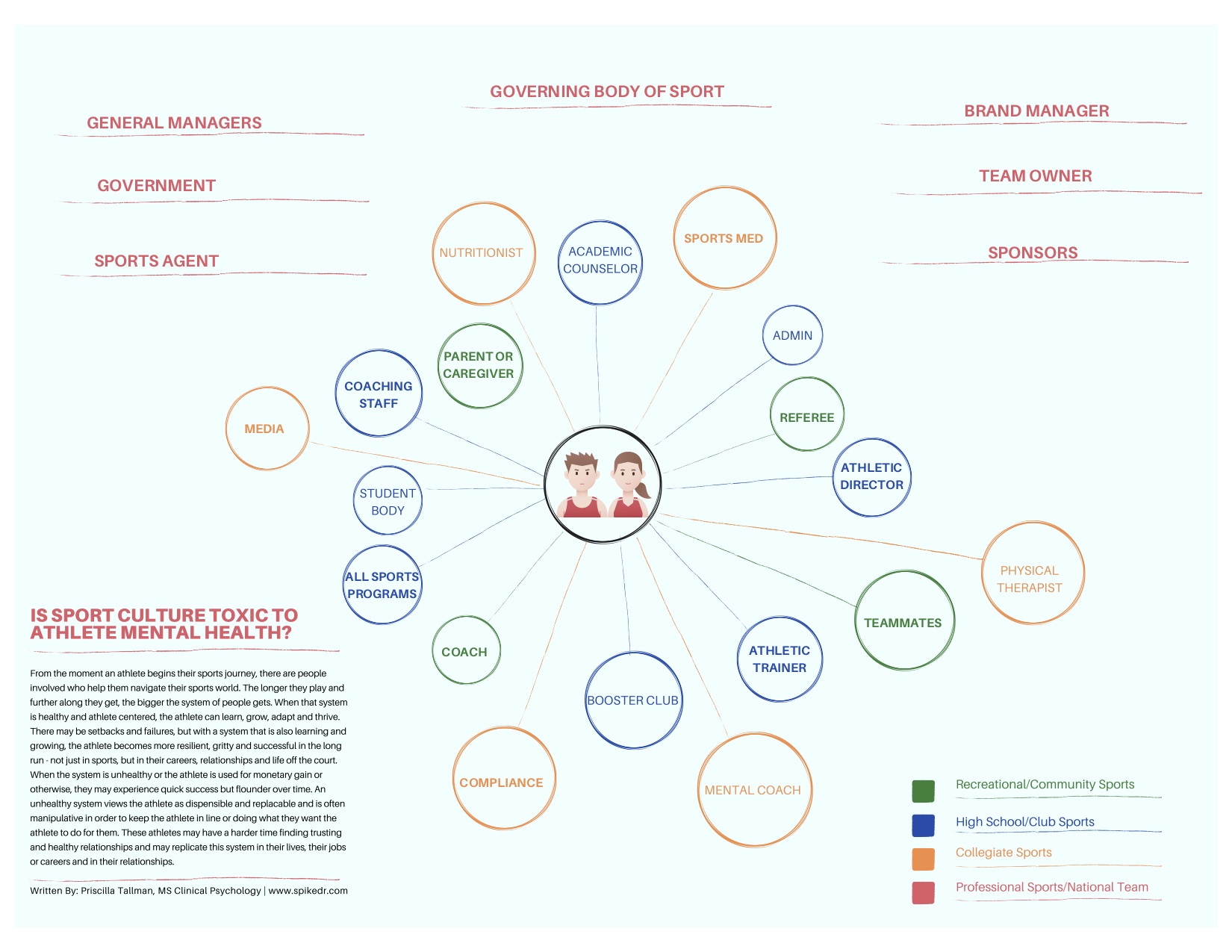
Let’s begin here. The graphic above is one I created for the panel conversation and demonstrates the various levels of sport. Each color represents a different level of play and each circle anther person or group of people who contribute to an athletes sports journey – from recreational play all the way to the pros. As you can see, the longer an athlete plays, the more people they are responsible to. As for reaching the professional level, I am aware of another graph published and circulated years ago by the NCAA on the percentages from each sport that end up playing beyond high school (the link has since been removed likely because it’s old data, but here’s what the NCAA has published since).
If you are like me and have been following recent studies and trends, you know more than 70% of youth athletes stop playing their sport right around their junior year. This could be the result of many different reasons: when an older athlete doesn’t make varsity and chooses to try something else, developmentally they want to be more social, school and sports and/or family life are too much to balance, no opportunities outside of high school sports besides pricey club options, other financial reasons to stop playing like they need to have a job to support family responsibilities or personal expenses – to name a few.
Enter burnout. Burnout is a physical or mental breakdown caused by over working, over training or excessive/chronic stress as a result of playing sports. But what if there’s another, less logical and more emotional reason for kids leaving sport? What if burnout isn’t as simple as training too much, not having fun anymore and just wanting to live normal lives.
Though I’ve not conducted research studies, I have had my own experience as a collegiate and professional athlete and have coached thousands of athletes as a sports coach. My main theory on burnout is that instead of only being a function of doing too much or training too much, it’s a function of mismatched values. Values between a coach and an athlete, a parent and an athlete, a sports culture and an athlete.
From the moment a child kicks his first soccer ball, throws his first tiny, plush baseball or bounces a Spiderman bouncy ball we start dreaming big dreams for them. If we’re honest, we’ll look back at baby pictures and see we’ve dressed them in little miniature jerseys of our favorite sports teams. If we played sports, look out because they will either be better than we were or they will never live up to what we’ve dreamed up for them.
And, they aren’t even five yet.
Whether we want to see it or not, our kids first exposure to sports culture is our homes. This doesn’t matter what demographic or socio-economic status you fall under. What we think about sports will trickle down to what they think about sports. Even the parents with the best intentions will struggle to separate their own desires for their kids with what is actually best for their kids. Sometimes we get it right and sometimes we don’t. Here are a few things I’ve heard at ball parks, soccer pitches, volleyball gyms and everywhere in between.
“Oh, they want to train six days a week.”
“They beg me to take them to weights and conditioning.”
“She’s had a tennis racket in her hand since she was 2!”
Now, I’m not saying those things aren’t real and those things won’t benefit a child or a future athlete, I’m just saying they came from somewhere. Babies are not born with intrinsic drive to perform. They are born with intrinsic drive to be nurtured and loved and be cared for and as they get older, they will do anything (even practice six days a week) in order to feel that.
LESSON #1: The first place sport culture starts is in the home and from our first caregivers. And, that’s okay, just know you are part of defining that and however you choose to do that will set patterns for future mental health and wellness.
As the child’s sports experience broadens, they will be exposed to various other cultural influences from coaches, the sport itself, the level of sport played and various other influences. My graphic above shows that from the moment a child begins sports, the opportunity to start building healthy mental wellness habits and skills is available.
Most sports programs are aware of mental health issues at some level, but most programs, including recreational leagues, have no idea how to implement skills and exercises that address it at these younger levels. Coaches at these levels are often volunteers and parents who are doing crowd control. And before you think I’m dissing the volunteer and parent coaches, I’m not – my husband and I have done our fair share. I am saying that we can coach and add in good, healthy mental skills at an age. An hour of fun from a supportive, encouraging parent or volunteer coach is a mental health skill.
LESSON #2: Even at the most introductory levels of sport, we can begin to implement mental wellness skills like fun breathing exercises, communication skills and having a basic understanding of the developmental stages of the kids they are coaching. Support, safety and encouragement are a priority and those habits begin at the youth level. We create the team culture at any age.
As athletes progress to high school and club levels, their cultural exposure shifts to whatever values those clubs and institutions embody. Some higher rated clubs and programs may focus on outcomes, win/loss records, getting athletes seen by scouts or college coaches. Other programs may be more focused on the whole athlete experience, academics as a priority, community service and the athlete’s goals after sports. Developmentally, however, the high school years are when we start seeing more burnout and injuries as pressure mounts for them to do more as they begin their foray into young adulthood.
It is during this time when teenagers are at an age that developmental psychologist, Erik Erikson, would call “Identity vs. Confusion.” These are the years when children and teens are forming their social identity and figuring out where they fit within their peer groups. This is an extremely difficult time as they are simultaneously separating from their parents and also still dependent on them for many physical and emotional needs. They also need a lot of naps.
Coaches, admin, academic advisors, teachers, college scouts (if applicable), sports med, friends, teammates and yes, still parents, all become a regular part of the culture that builds a system around the athlete. In an ideal world, this system builds physical, emotional and mental health into the sports experience. Unfortunately this often gets silo’d off and instead support it feels like a bunch of people they have to figure out how to please. Sports at this age becomes more stressful and athlete personal values begin to develop as they navigate their own personal identity.
LESSON #3: When athlete values and sport program values begin to differ, there’s an opportunity for growth and learning. When we dismiss their values and who they are becoming (even if it varies greatly with our sports team culture or family sports culture) athletes experience burnout. Sports is no longer fun because now they have to work hard not only to be good at their sport, they have to work hard to be good at a value system they may be struggling to understand or fit into.
If an athlete makes it to the collegiate or professional level, they have likely already internalized the various cultures they have been a part since they began playing. Each team they played for has either reinforced or helped them rework values based on their team cultures. Colleges usually recruit to their cultures – when those values match, its usually a great experience for the both the athlete and the university or college. When those values are healthy and support mental health and wellness and provide resources that put the athlete first, that’s the best case scenario.
LESSON #4: When values and cultures do not put the athlete first or do not provide resources that athletes have clear access to, mental health issues are sure to continue and perpetuate. Ask yourself, are my athletes better and healthier because of this experience or are they more confused and more stressed?
I love sports and team culture as a vehicle to teach and grow athlete and coaches. Our responsibility as coaches, administrators, sports medicine, teachers, parents and athletes is to have these conversations often. To grow and learn on our own, not just in the systems that create winning records, but in the systems that create winning communities, societies and cultures. I hope I didn’t answer the question for you, but allowed you to think about what your program or family culture looks like and what conversations you can be having to do what is best for the athletes in your life.
If you’re still here, thank you.
Priscilla Tallman is a freelance writer in Phoenix, AZ. She has an undergraduate degree in Psychology and graduate degree in Clinical Psychology. She has written for FloVolleyball, Volleyball Magazine, The Art of Coaching Volleyball, Sweat RX, Gorgo Fitness Magazine, CrossFit Fury, The CrossFit Games and OPEX Fitness. She has also written two performance mindset journals:
She is an 2x All-America volleyball player from the University of Georgia, SEC Freshman and Player of the year and was inducted into UGA’s prestigious Circle of Honor in 2006. She has played on the US National Team and enjoyed a bit of professional ball in Europe and on the beach. She has coached at the youth, high school, club and collegiate level. She is married with two children and currently coaches performance and mindset journaling to youth and college athletes and coaches.
“Mom, why didn’t you put me in baseball when I was six?”
My ten year-old’s words swirled through the air as we made our way through the parking lot after an evening little league game.
I lost myself in thoughts playing rapid fire in my brain.
Did I rob him of precious reps by not putting him in t-ball or coach pitch?
Had I squandered his preschool and kindergarten years because I wasn’t ready for team sports yet?
I searched for reasonable answers, but decided to remain silent … and anxious.
The tapping of his cleats on pavement brought me back to the parking lot.
PARENTAL FOMO IN SPORTS
“Our anxiety is a call to action generated by the monkey mind’s perception of threat,” Don’t Feed the Monkey Mind, Jennifer Shannon, LMFT
What happened in that parking lot was pretty simple and happens at little league and gym parking lots all over the country. My anxiety, created a response in me and made me want to do something to fix it.
Not fix my kid or answer his question, but fix my anxiety.
It’s an important distinction to understand, because there is a difference between addressing our kids question and addressing our own anxiety. My kid asked a question, he did not question my parenting.
See what I did there?
My kid wasn’t anxious. My kid was curious.
When your anxiety makes you think you are missing out, you are experiencing parental FOMO (Fear of Missing Out for those of you who still don’t know what that is).
Your brain gets hijacked and starts thinking things like “oh my gosh, I’m responsible for my kid missing out on x, y or z.” These initial thoughts, or what cognitive behavioralists call automatic thoughts*, aren’t inherently bad. It’s normal for most of us to question a decision even when we’ve planned or thought it out for months. Most of the time, we experience the anxious feeling, remember why we chose what we chose, and move on. Sometimes though, these thoughts don’t stop in the parking lot and you are no longer addressing your kids question, you are doubting your parenting and that can make us do a lot of crazy things.
“When hijacked by anxiety, we adopt the monkey mindset, which assumes that in order to be safe we must be certain of al outcomes, we must be perfect, and we must be responsible for others’ feelings and actions,” Don’t Feed the Monkey Mind, Jennifer Shannon, LMFT
Here are some of the actions taken because of Stage One FOMO aka YOUR anxiety:
Coaching your child loudly from the stands.
Comparing your child’s ability to the ability of another child.
Scrambling to schedule private lessons for a child who has never played, but is trying out in two days.
Yelling or approaching a coach after practice because of playing time.
Blame other players or coaches for a loss or bad practice.
Yelling at an umpire or referee because of a bad call.
Embarrassing your child, their coach or their teammates.
Trying to keep your child from the inherent struggle that is built into sports (see all of the above).
Remember, kids are supposed to have a range of experience, struggle, disappointment, success, joy, happiness, etc. in order to develop a wide range of life skills and the resiliency they need to thrive. As a parent of young children just beginning their journey into sports, dance, music, preschool or whatever, it can be confusing to discern the difference between helping your child and your own parental FOMO.
THE AMYGDALA AND PARENTAL FOMO
“When there is a perception of threat, the amygdala set off an alarm system that alerts their neighbors, the hypothalamus and the adrenal glands, which in turn send hormonal and neurological signals to the sympathetic nervous system, instructing it to accelerate the heart rate and breathing, bathe you in stress hormones, and shut down digestion and other necessary functions – in short, to go into survival mode,” Don’t Feed the Monkey Mind, Jennifer Shannon, LMFT
It’s sort of like a fire detector. Every experience, every sound, smell, feeling or thought passes through the amygdala and when it smells smoke it signals our brain and our body to take action, because, duh, fire. Our brain shuts down even the ability for our body to digest, making the amygdala the ruler of all. We begin to think of multiple scenarios (see automatic thoughts*) as to what might possibly go wrong. Our bodies then summon the proper response for those scenarios: shallow breathing, sweaty palms, signing up our kid for private lessons, yelling at a coach, blaming teammates for making mistakes … Wait. What?
Yep. Instead of surveying the situation, taking a moment to understand the context and simply fanning the smoke away from the detector, your freaked-out parent self sends in a whole crew of fire fighters and a ladder truck to douse the place. You know, just in case.
The thing is, dousing the place neither solves the problem nor creates a healthy response for you or your child going forward.
ACKNOWLEDGE THE FOMO, DON’T FIX THE FOMO
This isn’t about saying you’re a bad parent (that’s your amygdala speaking), it’s about learning to recognize our own process so we don’t douse our kid with a fire hose every time they sit the bench or experience adversity in youth sports.
The amazing thing about our pliable brains is that your anxiety isn’t fixed. We can learn to be less anxious and we can learn how to manage our automatic thoughts so we respond thoughtfully and intentionally. Acknowledging our initial thoughts and overactive amygdala takes work. The more aware, the better we can guide our kids through difficult situations instead of keeping them from it. The better guide we are, the more resilient they become and the more prepared they are for the various ups and downs that come with not only playing sports, but living life.
Raising kids and navigating the waters of sports, music, school or anything else is a marathon, not a sprint.
Priscilla Tallman is a freelance writer in Phoenix, AZ. She has an undergraduate degree in Psychology and graduate degree in Clinical Psychology. She has written for FloVolleyball, Volleyball Magazine, The Art of Coaching Volleyball, Sweat RX, Gorgo Fitness Magazine, CrossFit Fury, The CrossFit Games and OPEX Fitness. She was an 2x All-America volleyball player from the University of Georgia, SEC Player of the year and was inducted into UGA’s Circle of Honor in 2006. She has played on the US National Team and enjoyed a bit of professional ball in Europe and on the beach. She is married with two children and currently coaches high school beach and indoor volleyball.
There are only two details I remember about this match. That I played the absolute worst match of my collegiate career and the epic tantrum I threw in the locker room after.
Now, if you want details of said tantrum, you’ll have to ask my former coaches and/or teammates, because, honestly, I try not to beat myself up over things I did when I was twenty.
Over the past couple of weeks, the high school beach volleyball team I coach was playing in our state championship tournament. We had a really great season and headed into the state finals with a 13-0 record. A lot of really good work, consistent practices and managing of schedules had already taken place for us to be here, which was remarkable in and of itself, a state championship was the icing to a well-fought season.
The team we played also had a winning record, so, on paper this should have been a close match. Despite a great win by one our 5’s pairs, we lost the dual 4-1. In high school beach volleyball, five pairs player each other (5’s play 5’s, 4’s play 4’s and so on and so forth until the 1’s) and the best of those five pair matches wins the dual. It’s similar to the pairs tennis format in high school and college. After our loss, the girls were rightfully disappointed, but what I noticed in some of the athletes was more than disappointment.
Trust me, I’ve been there. Far too many times for way more reasons than just losing a game.
See, when a seasoned athlete loses a match or does not perform to their best ability, their brains have to make quick sense of the experience. If you understand your sport or your athletic journey is a process, then your brain takes any unfavorable performance (or any favorable one, for that matter) and says “here’s what I did well, here’s where I can improve, I’m not happy about this, but I’m going to find 1% more on my next effort.” Whether that’s in their nutrition, mindset, strength training or conditioning, sleep, recovery or whatever – this athlete will press forward and find ways to improve at every effort.
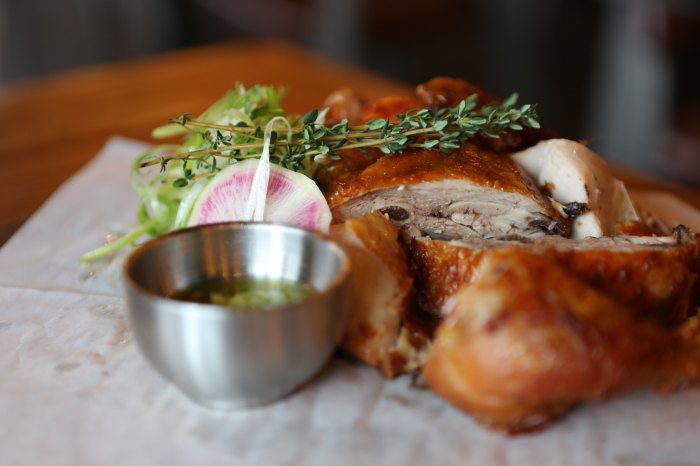
I call that CHICKEN AND BROCCOLI thinking.
Let me explain.
One night my son was balking at having to eat broccoli and chicken instead of the crackers and chips or whatever else he was wanting. I told him “every time you put chicken and broccoli in your body, you are filling it with good nutrients and things that will help your body grow and function properly. Every time you put in crackers and chips or something easy, you just fill yourself up and lose that opportunity to nourish yourself.” Of course, he did not love my example, but he understood at a basic level that you can fill your body with fast food or the quick and easy or you can fill it with nutrients and promote growth and performance.
The same can be said with our automatic thoughts after a poorly executed game strategy or a performance you thought was not your best.
Listen, if you do not understand your sport or athletic journey as a process (and if you are young, you probably don’t see the big picture yet), you may say something like this to yourself: “I played terribly. I SHOULD have won. I COULD have done more. It was my fault. I played bad, I should never play bad. I’m better than that.”
This kind of thinking is not CHICKEN AND BROCCOLI thinking. This is crackers and chips. This mindset is fast and easy and it doesn’t nourish our brains to make sense of the experience whether we lose or whether we win.
This kind of thinking keeps us stuck.
This kind of thinking creates entitlement and blame.
This kind of thinking is not sustainable.
Let me repeat that.
This kind of thinking is not sustainable.
After my monster tantrum in the locker room at Duke in which they sent my assistant coach and my best roomie in to check on me, I proceeded to beat myself up mentally.
I didn’t just beat myself up over that match or that night, I continued to feed my brain chips and crackers for years and found ways to blame myself and others for more than just volleyball matches.
I spent years minimizing the good things about my four years of college sports instead of seeing the bigger picture – lifelong friends, a college degree and a chance to play internationally after graduation.
See, we will get good at what we practice whether that’s passing and setting volleyballs or destructive self-talk.
We have to practice being kind to our mind and that doesn’t mean lying to ourselves and puffing ourselves up. It means plugging into the process and finding improvements where we can in the midst of disappointment – and, like, that’s hard.
So, do this for me. Commit to improving your post-match and post-practice thoughts.
Ask yourself questions instead of polarizing the experience of good or bad. Ask yourself “what did I do well today, where can I improve next time? What would I like to see/do next time I’m on the court?”
Then go out and do it.
Priscilla Tallman is a freelance writer in Phoenix, AZ. She has an undergraduate degree in Psychology and graduate degree in Clinical Psychology. She has written for FloVolleyball, Volleyball Magazine, The Art of Coaching Volleyball, Sweat RX, Gorgo Fitness Magazine, CrossFit Fury, The CrossFit Games and OPEX Fitness. She was an 2x All-America volleyball player from the University of Georgia, NCAA statistical leader, SEC Player of the year and was inducted into UGA’s Circle of Honor in 2006. She has played on the US National Team and enjoyed a bit of professional ball in Europe and on the beach. She is married with two children and currently coaches high school beach and indoor volleyball. While mindset is certainly a passion of hers, she still believes in good old-fashioned hard work, strength and conditioning and laying it all out on the line when you get your opportunity.
For more information on CHICKEN AND BROCCOLI thinking, see:
I try to keep this blog to sports content as much as possible, but the truth is, I’m not just a former athlete, mom and wife, turned coach … I’m also just a regular person with regular issues and stuff I deal with like everyone else. I don’t have all the answers, but I do have something even more powerful than answers.
I have my story.
So, a slight deviation from my sports content for some real business, because after several chats with other regular humans this week, I figured maybe y’all could use some real talk too.
When I was a kid, I used to bite the skin around my fingernails.
Like if there was a hangnail, I’d just get my teeth on it and pull it right off, quick and easy.
Sometimes I’d get more than just the hangnail and have to work my way around the nail to even out the skin. I didn’t like if the skin was uneven, so I would work at it until it was. Sometimes I would get a piece of skin that was a little too thick or too attached and my fingers would bleed. It wasn’t self-harm, it was just kind of something I did when I was anxious, I guess. Some people bite their nails, I pulled my skin from the nail bed. Sorry, if you think that’s gross, it’s just what it was.
And so, even though I was a quiet, introspective kid, my nervous system was busy running laps, jumping on trampolines and doing cannon balls off the high dive.
My mom did not like this habit of mine. I was told repeatedly to get my fingers out of my mouth and she had me use that really gross tasting “nail polish” on my fingers so as to trick my mind into thinking “this is gross, don’t put your fingers in your mouth anymore.”
My brain was like “pssshhh, childs play.” So, I just washed my hands and continued my skin removing work.
Eventually, she took me to the doctor. My pediatrician to be exact. I’m not sure what she thought he was going to do there. Was there a vaccine for this? Would a prescription for an antibiotic help this finger biting child? Why won’t she stop doing this? Doc, can you give me a medical diagnosis for this ailment?
Turns out, my finger biting wasn’t a medical issue – it was anxiety. But back in the days of Gilligan’s Island reruns and the Brady Bunch in Hawaii, nobody talked about anxiety, especially in my family, especially in children. Most people tried (and still do) to treat the behaviors instead of understanding how/why they started doing it OR better yet what is maintaining said behavior.
I mean, what was all that finger biting about?
A coping strategy, albeit a gross one, to manage my anxiety and I won’t go into it here, but I had plenty to be anxious about.
Alas, I did grow up and every grown up has everything all figured out, so this is where this story ends … haha … jk … nobody’s got nothing figured out completely.
Here’s the thing. Not one human being is exempt from the human experience. Whether we bite the skin around our fingernails or we blame others for our issues, hurt others because of our issues, cut or self-medicate with drugs or alcohol or sex or porn or whatever, if we are human we will try to find a way around our suffering.
Here’s the beautiful thing: pain, suffering, sometimes deep or debilitating sadness are all ways to experience joy, peace, happiness and connection. Like, if we don’t understand heartache, we will never understand love. I’m not saying we need to be miserable or harm ourselves or use destructive coping strategies to succeed at being human, but I am saying we will all experience a vast range of emotions, experiences, struggles (and also triumphs) throughout our lifetimes. When we can talk about these things (no matter how scary they seem) and connect with other people who have gone through similar things, we can grow, heal and move forward ever so slightly.
I don’t bite my fingers anymore.
I pick them.
That’s right, true story.
See, I still have anxiety. I’m also still a wife, a mother, a coach, a writer, a lifetime athlete and much more. My anxiety isn’t debilitating, I’ve learned to manage it and I have healthy coping skills to keep me in a good (great place, actually) 99.9% of the time. But I have my days and I guess my point to this whole thing is everybody is dealing with something. Ain’t nobody up in this place with no baggage.
We all have it.
Most beautiful part is knowing my honesty and authenticity about it might help someone else who is still hiding it. Hiding our imperfections or our humanness is actually scarier than just saying “I’m human. I’m in process and I’m cool with that even if it makes you uncomfortable.” Opening up and sharing real life is owning our process and showing up exactly how we were meant to be.
Priscilla Tallman is a freelance writer in Phoenix, AZ. She has an undergraduate degree in Psychology and graduate degree in Clinical Psychology. She has written for FloVolleyball, Volleyball Magazine, The Art of Coaching Volleyball, Sweat RX, Gorgo Fitness Magazine, CrossFit Fury, The CrossFit Games and OPEX Fitness. She was an 2x All-America volleyball player from the University of Georgia, NCAA statistical leader, SEC Player of the year and was inducted into UGA’s Circle of Honor in 2006. She has played on the US National Team and enjoyed a bit of professional ball in Europe and on the beach. She is married with two children and currently coaches high school beach and indoor volleyball.
*DISCLAIMER: I am not a licensed professional therapist. If you or someone you care about is experiencing anxiety or depression, please get help. Anxiety and depression are treatable and there are a varieties of effective therapies and treatment plans. I am thankful for my education in this area it helped me to understand that the best thing I could do was get honest about my struggles and ask for help.
I am constantly taking in information whether spoken or sensory or relational dynamics or environmental or that mosquito that just landed on your leg and now I’m focused on … (slap. sorry).
I don’t try to process all that information on purpose, but being introverted and introspective with a ridiculously keen sense of hearing lends itself to some extra perks, I guess.
Over the years, I’ve learned how to take in more information, process it more quickly and move on instead of getting stuck or slapping flies off strangers when they least expect it.
But, so what? Who cares? Why does this matter?
Here’s why. Because at some point you will have quiet athletes that you coach or play with and they won’t give you the feedback during training, practice or games that you typically see in team players. They might look mad, upset or like they aren’t listening, but it could be that when they are playing, their mind is completely quiet and that quiet is good for them.
As a coach, when I see these players, I don’t try to transform them into cheerleaders or change their game completely, but I do try to move the needle a few degrees and get them connected – after all, a team sport does require interaction with other people and having a coach (or boss, spouse, children of your own someday) means responding to feedback isn’t just being nice, it’s actually a life skill that transcends playing sports. Here are some examples that may help you understand more of what I’m talking about:
-> “BY MYSELF” IN THE GROUP: I like being in a group on most days, I don’t mind being in a class, but I am constantly keeping track of people (processor, remember). Whether it’s my family, my kid’s schedules, my own schedule, the team I coach or any other information I am tracking, when I get to the gym, I don’t want to keep track of anyone else. Some days that means I do a group class, some days that means being in a quiet gym with no other people and no music. It really depends on the day and what I’m carrying around in my head at that moment. Players can be this way too. Maybe tracking a million things in their mind and their sport is the only time their head is quiet and still. They might seem distant or “by themselves” but it could be they need some time to assimilate before they jump right in.
-> I’M NOT TRYING TO BE COUNTER-CULTURE: Understanding yourself as a coach or a player can help your whole team. When I first came back in to coaching and had my first all-day tournament in a loud gym with non-stop stimulus, I asked my head coach if I could go somewhere quiet and just shut my eyes and put in my ear buds. I explained that I wasn’t trying to be apart from the team, but that I just needed a little time away. In my first year, I didn’t want anyone to think I wasn’t on board with the team or the culture, but my brain needed some peace. I can handle a bit more these days in noisy gyms, but now the head coach and I both know when I pull my sweatshirt hood up over my head and put my ear buds in, it’s time for my “sensory nap.” I try to recognize this in players as well and distinguish between a player who needs a break from the noise to refocus and a player who has a bad attitude and is destructive for the team – it can look similar, but it’s two totally different things.
-> I LIKE PEOPLE, I LIKE GROUPS AND I LIKE QUIET TOO: I truly enjoy people. I enjoy listening to their stories and processing all the unspoken information so I can ask follow-up questions. I am a sucker for a good story. But at the end of a long day, perhaps at my child’s 7:30 start for a baseball game, I’m just going to sit by myself and enjoy that I have nothing to do but watch my kid. Some players are this way too. All of their social credits have been used up before they get to practice. It’s never an excuse to be rude or take things out on your teammates (sorry to everyone I played with when I was younger), but knowing this about ourselves or the players we coach can help us utilize that valuable 10-15 minutes of warm-up to not only warm up our bodies, but our minds and our emotions as well (yes, athletes have emotions too).
What to do if you think you might be like this:
remember there are other people outside of your quiet mind that are depending on you.
give yourself a high five count and stick to it. Like “I’ll give my teammates at least 15 high fives during this match” – this encourages and communicates connection.
make an effort to look up and at your teammates. Make eye contact during your match to remind your team, I’m still here.
use your warm-up to warm-up everything from your body, to your mind to your emotions – yes, athletes have emotions too.
be thankful for your quiet time when you get it and charge up when you can. Don’t be too hard on yourself for not being the loud one.
BOTTOM LINE is this: being an introvert or being quiet is not an excuse to be a jerk (again, my apologies to my former teammates), but awareness of how to best utilize this part of your personality will help you become a better teammate AND probably help you win more games – just sayin’ because most of us still care about winning too.
Priscilla Tallman is a freelance writer in Phoenix, AZ. She has an undergraduate degree in Psychology and graduate degree in Clinical Psychology. She has written for FloVolleyball, Volleyball Magazine, The Art of Coaching Volleyball, Sweat RX, Gorgo Fitness Magazine, CrossFit Fury, The CrossFit Games and OPEX Fitness. She was an 2x All-America volleyball player from the University of Georgia, NCAA statistical leader, SEC Player of the year and was inducted into UGA’s Circle of Honor in 2006. She has played on the US National Team and enjoyed a bit of professional ball in Europe and on the beach. She is married with two children and currently coaches high school beach and indoor volleyball.








 Priscilla Tallman is a freelance writer in Phoenix, AZ. She has an undergraduate degree in Psychology and graduate degree in Clinical Psychology. She has written for FloVolleyball, Volleyball Magazine, The Art of Coaching Volleyball, Sweat RX, Gorgo Fitness Magazine, CrossFit Fury, The CrossFit Games and OPEX Fitness. She was an 2x All-America volleyball player from the University of Georgia, SEC Player of the year and was inducted into UGA’s Circle of Honor in 2006. She has played on the US National Team and enjoyed a bit of professional ball in Europe and on the beach. She is married with two children and currently coaches high school beach and indoor volleyball.
 Let me explain.
 Priscilla Tallman is a freelance writer in Phoenix, AZ. She has an undergraduate degree in Psychology and graduate degree in Clinical Psychology. She has written for FloVolleyball, Volleyball Magazine, The Art of Coaching Volleyball, Sweat RX, Gorgo Fitness Magazine, CrossFit Fury, The CrossFit Games and OPEX Fitness. She was an 2x All-America volleyball player from the University of Georgia, NCAA statistical leader, SEC Player of the year and was inducted into UGA’s Circle of Honor in 2006. She has played on the US National Team and enjoyed a bit of professional ball in Europe and on the beach. She is married with two children and currently coaches high school beach and indoor volleyball. While mindset is certainly a passion of hers, she still believes in good old-fashioned hard work, strength and conditioning and laying it all out on the line when you get your opportunity.


 Priscilla Tallman is a freelance writer in Phoenix, AZ. She has an undergraduate degree in Psychology and graduate degree in Clinical Psychology. She has written for FloVolleyball, Volleyball Magazine, The Art of Coaching Volleyball, Sweat RX, Gorgo Fitness Magazine, CrossFit Fury, The CrossFit Games and OPEX Fitness. She was an 2x All-America volleyball player from the University of Georgia, NCAA statistical leader, SEC Player of the year and was inducted into UGA’s Circle of Honor in 2006. She has played on the US National Team and enjoyed a bit of professional ball in Europe and on the beach. She is married with two children and currently coaches high school beach and indoor volleyball.
 SpikeDr.com