Objects In Mirror*

Different, but strong in our own right...no comparisons here: Photo Credit: Trisha Madrid Photography
Different, but strong in our own right…no comparisons here: Photo Credit: Trisha Madrid Photography

As a little girl, I used to occasionally catch glimpses of my mother’s morning beauty routine. She might be looking here or there for some part of her wardrobe like those shoes or that necklace. Her hair adorned with neat rows of hot rollers pinned in their places and sprayed just enough to hold the curl. The vanity counter had a collection various sized bottles of potions for smoothing this or brightening that. Her makeup bag was filled with every color of eye shadow and lip color you could imagine. The process was magical and my mom was beautiful.

“Our first role models in life are quite simply mom and dad. In some cases it would be your primary caregiver if one or both parent is not present.” Dr. Jennifer Bellingrodt, Psy. D., Licensed Clinical Psychologist

Ever wonder why you think the way you do about your body or how you arrived at your current version of health? According to the psychoanalytic theory of object relations the image of and relationship to our mother and father turn into objects that we internalize and carry into adulthood as future predictors of our self-image.

Let me back it up just a bit.

Once upon a time you were a kid. You received information about who you should be and what you should look like from the external forces or objects working in your life (e.g. parents, grandparents, caregivers and environment). As a baby and then young child you internalized the information whether or not it was positive or negative. For example, if your mother was fashion or body obsessed, chances are you would be too. If your father never left his arm chair, then it may have been hard for you to view exercise as an important part of your life.

As we get older and begin taking input from various sources like peers or cultural media, the objects we first experienced may be cemented by what we see in our friends, celebrities and television. If they are healthy objects, then we make decisions based on health. If they are unhealthy, unbalanced objects we may have problems identifying how to treat and view ourselves and our bodies.

EMILY’S STORY

“I remember reading fashion magazines all the time in high school and college. No wonder I had body image issues! I think I started appreciating my own body and even as having my own beauty after I stopped reading those kinds of magazines.” Emily Lilo, CrossFitter

For the better part of her adolescent years and into her twenties, Emily dealt with body image issues much like many young women her age. Having children only exacerbated these issues and she remembers even considering cosmetic surgery to change what she saw in the mirror.

“After having children, I felt about as far from that ideal [body type] as I had ever been in my life. I had stretch marks and I just felt horrible about my body” says Emily.

Every fitness effort to this point was to lose weight and get smaller and so she started CrossFit to do just that. Much to Emily’s surprise, she started to see other bodies that were strong, beautiful and not “typical” of what she saw in magazines. Bodies that looked like hers. Ultimately, she came to appreciate her strength not only on the outside, but on the inside as well.

“When I found CrossFit, I saw amazing women who could do amazing things and they were proud of their bodies, the top women in CrossFit are great role models because they are strong, fit and muscular and they don’t fit that Barbie image,” says Lilo.

Emily credits CrossFit with helping her redefine her body image as an adult and to be able to convey a healthy body image to her daughter. “There are still days when I think ‘my legs are too big’ or something like that but it doesn’t keep me from doing what I know is healthy for me.”

MY STORY

“I am not the strongest person at the gym but I have learned how to work within the body I have been given and I feel strong and that is important to me.” Priscilla Tallman, CrossFitter

Tall and lanky as a teen, I remember wanting to have more curves. I kept thinking that eventually I would look like other girls or at least look more proportionate than I felt. I coveted the then “supermodel” look of Cindy Crawford or Helena Christensen, but still wore my baggy jeans and shapeless t-shirts – or sports clothes. After having children much of that changed, I was still tall but not so lanky and still no curves. I started CrossFit when my second child was nine months old and I still love it.

I never did get those curves, but I can climb a rope, do a pull-up and move a little bit of weight on a barbell and I’m proud of that.

Best thing is, I see all shapes and sizes of men and women and we applaud each other for the work we are doing and the progress we are making, not for what we look like.

And that is something we could all internalize.

*(This article originally ran in the Triune on October 14, 2013)

First Rule Of Parenting: Empathy First

They are little in a big world, we need to be there to catch them (photo cred: Jobrina Hofleit Photography)

Begin Scene:

Angry six year-old retreats to room, slamming door behind him.

After five minutes, mom goes to door and knocks lightly. Her face is concerned and she speaks softly:

MOM: “Hey, Buddy. Do you want me to make you some dinner?”

SON: (sounds of rustling paper) Thirty seconds later, son pushes a piece of paper under the door with the word “NO” written on it.

MOM: smiles to herself. Still standing outside his door, she asks “Are you okay?”

SON: (sounds of rustling paper) Thirty seconds later, son pushes a piece of paper under the door with the word “yes” written on it.

Mom smiles and walks away.

End Scene.


This happened in my house last week. My son was upset about something – can’t remember what that was anymore – and he went to his room for some “space.” This is a huge improvement from the toddler tantrums and the preschooler flailing’s about and even the five year-old holding his breath and hitting stuff stages. Okay, maybe there is still a bit of breath-holding, brow-furling, feet-stomping and name-calling. We are making progress, but there’s still much to learn.

Whenever my kids gets to a place where they are angry enough to hole themselves up in their room, I know something else is going on. It is never what it seems – surface level frustration just doesn’t exist once you’ve moved on to anger. Because, one thing I learned from my days as a therapist-in-training is that anger is a secondary emotion. It’s there to mask other things.

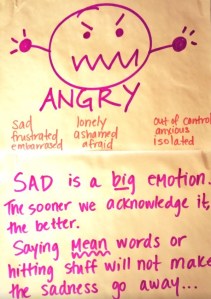
Anger hides all manner of other more overwhelming, but less charged, emotions like: sadness, fear, loneliness, longing, embarrassment, feeling ashamed, anxiety, being misunderstood – do I need to go on?


photo (4)

For a child who is still learning to regulate emotions, the ones hiding under their anger (like fear or sadness) can seem very big and overwhelming. Being angry is easy, it requires little or no risk. Being sad or afraid is very difficult, it requires vulnerability and the courage to feel. When our big, scary emotions start coming up, they usually get covered by anger and are expressed in a physical manner – like hitting or throwing something. It’s our job as parents to help our kids identify the big emotions, give them language for those feelings and help them find appropriate ways to express themselves in that moment. Trust me, in those split seconds of your kid retreating to their room and slamming the door, not many of us are thinking this way.

Parenting books will give you an arsenal of tools to “fix” the behavior, but it takes a moment of stepping back to really see what is happening. If we are in touch with our own emotions, we’ll be better equipped to identify theirs and be able to communicate and build relationship while making them feel safe to express the big scary stuff. Not so easy. I went to school for  eight years and trained as a Marriage and Family Therapist and did my own therapy for many years and this is still not my first instinct. But stepping back and looking at the whole picture always works for me.

I knew my son was okay. It took a moment, but once I identified what was going on, I met him on his terms to begin a conversation. See, I was gone all day and had just gotten home when the behavior started. I’m usually the constant for my kids. I pretty much never go anywhere. So, suffice it to say, when the constant goes away for the day you are sure to get some big feelings bubbling up that need expression – even if they are super excited to spend the entire day with their Daddy going on all kinds of boondoggles.

I thought back to other times my son had acted this was and took my best guess as to what was going on. He missed me and needed me to know that. He just didn’t know how to tell me and stewing in that big emotion all day had worn him down. He was emotionally exhausted.

With my son and I still separated by the safety of his bedroom door, I slid a note under to him (I met him on his terms). It said this:

“I LOVE YOU. I MISSED YOU.” I drew a little picture and signed it “Mommy.”

Rustling of paper, popping of pen caps.

My note emerges from beneath the door with a picture of his own. I smiled and walked away and returned to what I was doing. My kid was alright. My work was done.

About a minute later he came to me with his dinner request, written in his little notebook and with a picture of how he wanted it prepared. Of course, I obliged.

If we fix our eyes on always trying to solve the behavior issue, we miss what our kids are trying to tell us. We miss the depth of what they are feeling and we miss opportunities to grow and build relationship. My son was able to go to his room, have his moment and come out having expressed some pretty big emotional stuff for a six year-old. I was able to identify that and give him words to what he was feeling. Then he felt safe enough to come out on his own and even tell me what he needed. That’s huge.

I have no idea if what I am doing is right or if it’s working, but I’m certain it’s building relationship and for now I’m cool with that.

There’s a Hero In This Picture

photo credit: Adam Bow

There is a hero in this picture.

She looks like a regular person (I guess most hero’s do), but she is extraordinary.

I ran to join in this picture  just as they were about to click the shutter. I popped into a hasty squat and was a little off balance so I grabbed the gals foot/ankle right next to me to steady myself. Not really a big deal, but let me back it up just a second.

Actually, let me back it up about two years.

I started CrossFit when my daughter was about nine months. I have the same CrossFit convert story that every CrossFitter has, so I won’t bore you with that.

I had been writing with our affiliate for a bout a year – mostly inspirational stuff I came up with on my own or athlete transformation stories I was assigned. I’ve never been a sports writer, but I was hooked. One morning, an interesting story came across the desk. The mother of an Army soldier called us to see if we would do an article on her daughter who had trained at our gym before she was deployed. Her mother was persistent and she wanted her daughter’s story told.

It went something like this: while in Afghanistan and competing in the Asia Region for the CrossFit Open, this Army soldier’s competition season came to an abrupt end. Working as a humanitarian aid to Afghan women, she and her team were “patrolling the perimeter of a location when their vehicle hit an improvised explosive device. The impact beneath the vehicle left them bruised, sore and injured.” Although no one on the team suffered any life-threatening injuries, fractures to the bottom of both heels were enough to keep our soldier off her feet and out of competition for almost ten weeks.

I wrote up the story and posted it to our affiliate’s site. It then caught the attention of CrossFit HQ and I had an opportunity to speak with the now stateside Army soldier over the phone. Hearing her story and listening to her speak made me realize the calling of my life. I was put here to tell stories. Not always my own, but I am supposed to tell them. I got off the phone with her and felt incredibly humbled by the opportunity. I remember sitting in silence in the parking lot just thinking “every story matters.”

When I tell a story, it takes up a little place in my soul. Someone’s experience takes up residence in my life – and when I tell the story, I learn from the story. Every single time.


From time to time, I would wonder what that soldier was up to and did she get back in the gym or did she ever open that affiliate she was hoping to open. Did she make it home to her family? Her mother? Will she compete again?

I think the CrossFit community is the most fascinating thing. Most communities exist as concentric circles – one circle inside of another circle inside of another circle and so on. Each community being surrounded by an invisible circle, it goes around and around, but it doesn’t ever touch another circle. There may be five, ten, fifteen communities all existing in the same area and, yet, they never touch.

CrossFit is this crazy bunch of overlapping circles. Each community exists in their own right, but instead of staying within our own people, we overlap. We blend, we connect, we share our experience.

Look at that picture again.

I’m the one kneeling in the front. My hand is on the girls foot directly to my right.

That is Rebecca Mendez. That is our Army soldier. Those were the feet/heels fractured in Afghanistan.

THOSE FEET ARE HELPING ME BALANCE. THEY ARE KEEPING ME FROM FALLING OVER.

Do you not see the rich and miraculous symbolism in that?

I had no idea when I hastily squatted in that photo that I would stumble across this today. It took my breath away.

I AM THANKFUL. Those feet are just one pair of the many feet that represent my freedom, your freedom, our freedom.

Thank you, Rebecca. Thank you to all the veterans and active military who represent my freedom.

Now, I need to sing the national anthem and cry because I am overwhelmed.

10 Things I Learned About Life By Playing Volleyball

I am 100% positive I hit that angle inside the block, while facing line, with horrific bangs, skinny legs and giant knee pads. 100%.
I am 100% positive I hit that ball angle inside the block, while facing line, with horrific bangs, skinny legs and giant knee pads. 100%.

Oh goody! A listicle!!

What started off as an effort to mock the listicle (a short-form of writing that uses a list as its thematic structure), blossomed into the fruits of my volleyball career slash psychology degrees slash six years experience as a mom. You can hate it or you can love it, but I’m not looking over at the bench on this one. In no particular order here are 10 things I learned by playing volleyball:

1. Clean Aces are Money – There are times in life that you get an ace. No one is ready for what you have coming and you get a point – just like that. You may get a string of aces or you may just get one or two in a match, but when the opportunity arises take it, be thankful and let that point to propel you to your next rally. You may not get one again for a while, so strike while the iron is hot.

2. Hit Hard, Watch Good Things Happen – I stole this from my husband, but he’s right. Hit the ball. Stop being afraid to swing – hard. You might not be able to power through a three-man block on a low set inside, but it’s gonna sound good no matter the outcome. Swing away.

3. Life is All About Angles – I got a boat load of kills and broke school and national records hitting two shots: angle and more angle. Life is about angles. Not everything you encounter will be cut and dry. Not every path is marked off. You’re gonna hit some rocky terrain or stumble across sudden turns and forks in the road; the better you are at adapting to all the angles, the better off you will be.

4. Still Sometimes You Gotta Hit Line – I can barely even say the words “hit line” but sometimes it must be done. Sometimes you have to go against the sure thing and hit line. That middle is too big, that ball is too low, everything is all wrong. Square your shoulders and hit the freaking line. And you better hit it hard, because if anyone gets a hand on it’s going to end up back in your face. The least you can do is take a pinky off the right side blocker if you don’t get a clean shot and it’s a kill all the same. Are we done talking about line yet?

5. Swing at Everything – Whether you hit it out or got blocked or kept the ball in play, at least you went down swinging. I embarrassed myself many times swinging at sets that I couldn’t hit, but that’s what eventually made me a good hitter. You have to be willing to take a chance and take a swing. In life or on the court, you’ll never know what you are capable of if you don’t take a swing.

6. Good Blocks End Plays – Boundaries are good for us. In volleyball, blockers are the first line of defense. Good blocks end plays and even touches take the heat off the ball. In life, relationships, work – you need boundaries. You need to be able to block out the toxic stuff in your life. You’re ability to say “yes” to the things that will make you thrive and “no” to the things that will drag you down can determine your success in so many ways. Remember, even the touches take the heat off the ball.

7. Watch the Setter – Being a great observer will get you everywhere. When you watch the setter, she gives you cues on where the ball is going. Outside, middle, over on two. When you observe in life you get cues on your next play. Watch everything. Track nuances. Read emotions and non-verbals. Learn to be an observer and act on what you see.

8. Don’t look at the bench – Unless you want to end up there, don’t look over there. Especially after a mistake. In my early years of playing, I spent most of my time on the bench. When I did go in, I was always nervous about making mistakes. For the most part, every time I made a mistake I was taken out. I made a lot of mistakes, so…I spent a lot of time on the bench. I carried this fear with me to my freshman year of college. In my first collegiate match, I missed a swing or something and immediately looked over at the bench. After a couple times doing this, my coach called a time out, pulled me aside and said to me “look, I’m not going to pull you out over one or two mistakes, so you can just stop looking over here expecting to be taken out.” And that was it. I never looked back over at the bench again. The confidence to trust myself and trust that my coaches knew what they were doing, even after I made a mistake, was huge – huge.

9. Losing Builds Character – Yeah, yeah, yeah. Whatever. Most of the time it just fuels the fire to win and sometimes it even makes you cry. This is true in work and in relationships. Losing builds character, but it totally sucks. Everyone has to endure a few losses, it’s just part of the game. Learn from it and move on.

10. Winning Feels Amazing – All wins feel amazing. I’ll take an ugly “w” over any loss any day of the week. In the famous words of Ignacio (Nacho Libre) – “I want to WIN!”

There you have it. Ten life lessons based on the sport of volleyball. I have applied number five right here by writing this listicle. I went down swinging.

Do You Love This Sport?

You have to believe that you can before you actually can.

Today I had the chance to coach a little volleyball. It doesn’t always work out where I can do this, but every time I do I am reminded how much I love it.

Don’t get me wrong. I love coaching the really good players. The ones everyone knows are gonna be good.

But my favorite moments come when there is this one little player who doesn’t realize that they have it yet. They don’t quite believe in themselves and these little ones are easy to spot.

My group was working on hitting.

After going over footwork for about ten minutes we gave them a ball and had the players toss the ball, approach to the ball and then catch it – not hit the ball, just catch it. It is the equivalent of watching paint dry for a volleyball player because all anybody wants to do it HIT THE BALL!! Footwork is pure torture. But it’s totally necessary.

Most of the older girls could do this easily. Approach, approach, approach. Toss the ball, approach, catch. Easy peasy. Then we got to the group of younger girls. Most of these girls needed  more time on footwork, but because we sometimes have to try something new and difficult in order to catch the mechanics of it, we had the younger group toss and catch as well. Not so easy peasy.

Most of the younger players struggled with getting both footwork and the hand/eye coordination of catching it in the same movement. The athletic girls took a few attempts and eventually got the timing of it. Even if they had wonky footwork, they were athletic enough to be able to get their feet close enough to catch the ball. We could tweak the footwork, after all. The smaller ones had a more difficult time.

One little girl caught my eye. She was frustrated. Cutest thing I have ever seen, but frustrated. I had worked with her on the footwork portion just minutes earlier and she was frustrated there too. Her feet seemed to betray her and when we added the ball toss, it was just too much. I heard her say “I can’t do this.” After a few minutes of this, I gathered the girls together and told them to hold up one hand.

“Hold up one hand. I want you to come up with five things (one for each finger) that you believe about yourself. These can be good things or bad things, we all believe both kinds of things about ourselves,” I said.

I could see their little wheels turning.

“You don’t have to tell me what these things are, but what I want you to do is focus on the good things that you believe about yourself. If you have yucky things you think about yourself, I want you to take your other hand, grab them out of the hand you are holding up and throw them up into the air. Get rid of them, right now we are just going to focus on what we CAN do,” I continued.

More little wheels turning and little hands tossing yucky things away. I dismissed the huddle and had them take a few more attempts at the toss and catch, then we moved on to another drill. A few minutes later, I saw the same little girl working on serves from the ten foot line. She was frustrated and looked as if she were about to cry.

I went over to her and said “you are doing great!”

She looked at me with tears welled up in her little eyes and said “no, I’m not.”

I said “Are you having fun?”

She put her head down and nodded yes.

“Do you love this sport?” I asked.

With eyes still downcast, she nodded yes.

I tilted my head to meet her eyes and said “Do you love this sport…?”

This time a verbal “yes.”

“Then pick up the ball and try again. If you love this sport, you will be good at it. I promise,” I said.

You see, that little one was me more than thirty years ago. My feet mocked me, my small, skinny frame betrayed me – but my heart…my heart…my heart didn’t freaking care.

I loved that sport. I believed that I was going to be good before I ever was. I believed (even when I doubted) before any coach ever did.

Eventually, there were coaches who believed in me, but that small, timid nine year-old on the verge of tears found a place in my heart to believe that despite the odds and despite what people told me – that I was going to be good just because I loved the sport.

I love talented athletes. I love natural ability and when I see it, it is beautiful. Amazing athletes doing amazing things with their bodies will always be something I am drawn to.

But those little ones with tears in their eyes and lions in their hearts? That is the real stuff of sports. That is the stuff I live for.

Power In Our Pain – Meet Shannon

Life goes in circles, reach out. Listen to one another. Seek to understand.

Most of us know that life doesn’t play out like a Princess movie. But even though we may be cognitively aware, our emotions don’t always play along. For some, the longing of finding their Prince and having a family doesn’t quite go away. This is not an argument for what a woman should be or hope for nor, is it a debate for or against female empowerment. This is just a story of a girl who wants to be a wife and a mother.

When you read this, do not pass judgment. We all want different things and everyone has a struggle that is real to them.

This is real to Shannon.

When Mommy Doesn’t Happen

Shannon is a 1st grade teacher. Her job is educating children, but anyone with school aged children knows that your child’s teacher is much more than an educator. The good ones aren’t caught up in curriculum and test scores alone, they are concerned with the character development of their students and they have a keen eye for the ones who seem to be struggling with burdens too large for their little shoulders to bear. They care for our children during school hours and no doubt think about them and talk about them long after the school bell rings. Good teachers are the mommies or daddies when our kids are away from home.

For Shannon, being a teacher was an extension of the dream she had as a little girl, to be a mother. When she was six, Shannon’s parents divorced, turning life into a confusing and complicated place for the little mommy-in-waiting. She was not interested in Barbie dolls or stuffed animals; in fact, she limited her play to her baby dolls as the main outlet to satisfy her natural maternal instincts. Her mother remarried when she was twelve, but it wasn’t happily ever after. Wounds that hadn’t quite healed from her parents’ divorce were amplified during her pre-teen years and the tumultuous relationships in her home only made things more challenging for Shannon.

She was sixteen when her little sister was born-the beginning of a sisterly relationship that at times felt almost maternal.  Shannon spent a lot of time taking care of and trying to protect her little sister from any kind of harm.

“I told myself over and over during that time ‘It’s okay, it’s okay, because I’m going to do it right. I’m going to have a loving husband and children, and we’ll love them and protect them.’ That’s when my anorexia began. Eating was something I could control in my otherwise out of control life,” says Shannon.

Just one week after her 25th birthday, she married her boyfriend of three years and began living her childhood dream – she had found a way out of the chaos and fear that had become her life. But vows that are committed on shifting sands often give way under the pressure of the tide. Shannon’s new husband became overwhelmed with her feelings of fear and despair; meandering the deep waters of depression and anorexia became too much and her husband was drowning. Shortly after it began, the marriage ended-sending Shannon into one of the darkest periods of her life.

“I think I mourned the loss of that dream more than anything. I felt hopeless and depressed, like I had failed. Those feelings are what led me to the place where I felt like I had no future and no hope. I felt so far away from God and confused about everything…and just decided I couldn’t go on,” she remembers.

Saved by Grace

In a very dark season of her life, Shannon made a decision to end hers. One night, she took a few handfuls of pills and left her therapist a voice mail. But God had a bigger plan for Shannon. By force of God’s grace, her therapist, who rarely checked messages after office hours, had checked voice mail to confirm another appointment when she heard Shannon’s message. She picked up the phone and called her house.

“I don’t remember what she said or how she intervened – and at the time I didn’t see it as much, but now I know there is a reason that my plan to end my life didn’t work. I feel like God wants me here for something. It’s not my decision to make anymore,” says Shannon.

Through therapy and a still-growing relationship with Christ, Shannon has worked through a lot of those feelings since that night. She has learned her worth and value, even when it isn’t easy for her to see in herself. When she struggles to understand why she still doesn’t have the family and children she longs for, she stands on God’s promises and believes in his plan for her life.

“I can still be pretty angry with God sometimes, and I even talk to Him about that. I didn’t then, and still don’t now, understand why my deepest desires haven’t been fulfilled. But I am learning to trust and believe there is purpose in my pain,” she adds.

Maybe the beauty of life is the winding road that leads  us not to perfection, but to grace.
Maybe the beauty of life is the winding road that leads us not to perfection, but to grace.

Victory in the Struggle

“I’ve been in some very dark places. I know what it feels like to believe that things are so hopeless that even one more day, one more hour, is too much to bear. But letting go isn’t an option. I have to tell myself that I don’t know (his plan), but God does. I can’t, but He can. That doesn’t make it go away or make it all better, but I know I can handle this – in this moment, right now – I can do this right now,” says Shannon.

In the meantime, she continues to teach and to pour into the lives of her students during the school year. She has had opportunities to use her gifts to help teach children in Africa, and to write curriculum for a mission trip to South East Asia for special needs children ages 3-18.

What she wants you to know is that her life isn’t a clean, everything’s-worked-out-perfectly happy ending. She still struggles, cries, and feels the very real pain and disappointment of not being married and having children, but Shannon chooses to cling to the hope that God has promised her. She chooses to believe that God has a plan for her life that, although it may not match up with the one she dreams of, has both purpose and fulfillment.

“It’s important for people to share their stories and their struggles, because sometimes it seems that everyone else has this wonderful, happy life. When we are open about our struggles, maybe we can help others. Maybe my pain and struggle can help someone else. Maybe I can offer comfort, even if it’s just that someone knows they aren’t alone. I still question God, but I know he is not apathetic or angry or absent. He can use me where I am with what I am dealing with. And He loves me right where I am…loves me enough to help me see purpose in my pain, and to offer hope in the meantime,” says Shannon.

unnamed (1)
Our pain can be the source of our greatest power. If we allow God in those dark places, he can guide us through our healing and we can reach out to others.

MOMMY Happens: II

What? He came out of the womb with an arm swing. I didn't push it on him.
What. He came out of the womb with an arm swing. I didn’t influence him one bit.

Yesterday I was sitting with a group of mama’s.

They are further along this journey called motherhood. I love hearing the things they are going through, the issues they deal with at different ages and stages of raising children. Their wisdom comes from experience, trial and error, perseverance and patience – not from a book. They have learned that sailing through one stage can mean choppier waters in the next one. They have learned to exhale and relax as they ride out a certain wave and how to savor the tiny twinkle in time that is complete bliss.

That moment is the commercial, the print ad – it’s the reason we signed up for parenthood in the first place. These are the moments when our hearts seem to grow a couple of sizes. These are the moments we can beam with pride and love because, “yes!,” we have done something right! These moments are to be cherished, wrapped up and tucked in our pockets to carry us through a more difficult stage or season of life that is peeking around the horizon.

One thing came to light during a brief lull in the conversation is that mommy’s worry.

We worry about our kids. A lot.

We worry just about everything. Our decisions that affect them, that virus that IS COMING, the internet, bullies, GMO’s, HMO’s, the zombie apocalypse, health issues, academic issues, food, shelter, clothing issues – I cannot write an exhaustive list, there are just too many to name and I know my worries don’t hold a candle to the stressors and worries of mommies all over this world and in this nation. Mine are minimal, I’m sure of it.

Thing is that I never really thought about any of this before I had children. I just went on my merry way making decisions that I thought only affected me. I did whatever I wanted.

I did whatever I wanted.

Then I became a mother and all of a sudden everything went laser focus. IT IS NOT ABOUT ME. How am I going to protect this tiny little human? I AM NOT EQUIPPED! No, seriously I have absolutely no idea what I am doing.

I’ve done a few things to keep my anxiety at bay. I don’t watch the news almost ever. I don’t read the news almost ever. I don’t read the many news links my mom sends me (I’m gonna hear it on this one) almost ever.

I am aware that not knowing what stories ran on the local news station last night (or ever) doesn’t make this stuff go away. I don’t live in denial, that’s not good or realistic place to live. I just try to protect my mind from the onslaught of evil and despair that can be 24-hour television watching (but does Walking Dead count – touche). I work hard to establish real, meaningful interactions with my kids. We don’t shirk our emotions. We talk openly about being angry, fearful, embarrassed, ashamed, tired, cranky, boastful, jealous, mean (people, those are just MY freakin’ emotions on a regular day).

We also talk about joy, happiness, peace, love, respect, dignity, kindness, serving others, compassion – believe me we are all still working on these virtues as a family.

It’s not just the news though. News has always happened. News will always happen. From the beginning of time people have been killing other people. People have been taking political and religious agendas out of context and using it as a reason to hate or harm another person. I get anxious because I know this truth: human beings are seriously flawed. We have the ability to extend kindness or deliver hatred all in one moment.

Did we learn nothing from Depeche Mode when Martin Gore wrote and Dave Gahan sang “And now your punching and your kicking and your shouting at me. I’m relying on your common decency. So far it hasn’t surfaced, but I’m sure it exists. It just takes a while to travel from your head to your fist.” ~ People are People

I know every single word to this song (thank you 1980’s and British pop) and I still struggle to be kind as frequently as I hope to be. I am passionate about treating people, all people, with respect and dignity and yet I still speak unkindly when I feel threatened. I still spew sarcasm on the daily and can eye roll myself out of a chair. The struggle is real. I have a God-given ability to write words and most days don’t do a thing about it because I can’t think of one nice thing to say. You see, I am anxious because I know at the gut level of every person (even the kindest people I know) we cannot always be nice. I touched on this in the first Mommy Happens post a couple of years ago.

No one really tells you about the deeper themes that begin to override all of our decisions until you are in the trenches of motherhood and begin to discover that all of us are having this conversation. Some of the circumstances may change, but the themes remain the same. I mean we can all learn to change a diaper, soothe a cranky baby or distract a naughty toddler. We can make our own baby food or buy it, we can nurse or bottle feed, we can do all the things that need done in a day but it’s those quiet thoughts that tap on our subconscious when we are lying down to bed at night or when the house is quiet for a moment. The moment we see the disaster half way ’round the world or the tragedy in our own community.

But, we cannot stay in that place for long. Let us not squander our time worrying about tomorrow. Tomorrow will bring enough worry of it’s own. Today, I salute all the mommy’s who are in the battle with me. The mommy’s who have much to worry about, but choose to just live one day at a time. I wish I could name all of the mother’s I know one by one and say something amazing about each one, but instead I will just list as many as I can right here:

Mary. Vanessa. Heather. Coliene. Kristin. Lenore. Amber. Kelly. Danielle. Dawn. Jennifer. Jen. Jenn. Carmen. Kristin. Rebecca. Kim. Lauren. Shayla. Tracy. Tracey. Adrienne. Susie. Jill. Beverly. Bev. Heidi. Marie. Nancy. Ann Marie. Ann. Lisa. Brittney. Julie. Melinda. Hannah. Karen. Caren. Karyn. Colleen. Tanya. Elizabeth. Liz. Valerie. Hilary. Ashley. Stephanie. Erin. Angie. Michelle. Tami. Megan. Kate. Katherine. Cathy. Deena. Pam. Cerita. Samara. Amy. Aimee. Beki. Tara. Barbara. Jezel. Erica. Erika. Jessica. Darcy. Marcela. Alice. Janet. Violet. Christine. Sharon. Melanie. Trisha. Patricia. Joy. Jamie. Sarah. Eva. Christie. Kristy. Helene. Natalie. Betsy. Teri. Theresa. Rachel. Leslie. Jacque. Jacqueline. Chantelle. Jackie. Lori. Laura. Laurie. Tammy. Jodi. Brooke. Susan. Kandi. Kimberly. Melissa. Jama. Danee. Whitney. Nicole. Lyn. Lynn. Linda. Shelly.*

*I know I did not get everyone. That only means that my caffeine has worn off. Also, if you see your name, it is you. I didn’t write a particular name more than once because – do we need to address the caffeine issue again? Plus, I seem know a large number of Mary’s and Kristin’s.

Dem piggies tho...
Dem piggies tho…

Bullyproof

This article  originally ran on the Triune on November 12, 2013.

bullyproof
An important reminder for kids and parents. Cliff notes: speak up.


“We just don’t like you. No reason. We just don’t” ~ Mean kid, Any City, USA

My former supervisor used to have this analogy about a kangaroo. He would say “if someone called you a kangaroo, would you believe them? Probably not. And why? Because you’re nothing like a kangaroo. That thought is absurd.” But what happens if someone calls you weird or fat or ugly or a loser? Think you might believe them now? You are more likely to believe them now because unlike the springy mammal, you might actually believe that those things are true.

Guess what? Bullies know this.

THE PROBLEM

“Bullies actually have high self-esteem. It seems counter-intuitive, but they are actually quite confident. The problem is that they have poor coping skills and trouble regulating their impulses. They know what they are doing is wrong but they think they are just ‘having fun.’” Dr. Tim Moyers, Marriage and Family Therapist, Journey’s Counseling Ministry.

Teens and tweens are becoming more and more bold and acting in sadistic ways as they hide behind the veil of social media and perceived invincibility. “These are kids who are prone to impulses without the ability to regulate. They may be picked on at home by their parents or siblings but in their peer settings they have high self-esteem” Dr. Moyers. Bullies take on a type of persona where they feel empowered to hurt others. There may be a power struggle in their home life, but when they are in control and harming others it feels good to them. It tells them that they are still important that they can still affect people – even if that means affecting them in a negative way.

“They shunned him and it worked. They told his friends not to talk to him anymore. He started to hide during lunch hour just to avoid them and because – they threw food at him.” Mom of bullied middle school student.

Unsure of the long-term emotional damage bullying would take on her son, Jessica needed something else. After more than a year of threats, mind games, social media embarrassment and very little administrative support from their school, this mother had enough. Eventually she transferred her son and added sports to his weekly activities. Ethan took to soccer and CrossFit and excelled. Jessica noted that he was a different kid when he was on the field or at the gym.

He didn’t have to worry about what kids were saying about him or where to sit for lunch, CrossFit and soccer offered him a different group of kids with a built-in community of mentors and coaches.

“The drama didn’t follow him there and CrossFit has just given him such a sense of confidence” said Jessica.

THE COMMUNITY

“Don’t break the sense of community. Involve teachers, administrators and other people who can help. In addition, therapy can help families learn how to take their lives back from the bully’s,” Dr. Tim Moyers, Marriage and Family Therapist, Journey’s Counseling.

In our harried and busy lives, parents need to take time to encourage their kids to speak up and to say something to an adult whether it be a teacher or a parent when they see bullying or if they are being bullied; when necessary professional help or counseling is an incredible tool for the family dealing with bullying. Bullies try to isolate their targets, keeping a sense of community and having various peer groups is helpful for the child being bullied to feel empowered and gain confidence.

THE CONVERSATION

“We have to teach kids to stand up for themselves without being confrontational.” Deana Gillespey, Dean of Students and CrossFitter.

Deana Gillespey is the Dean of Students at a comprehensive inner city high school of about 2,800 students. Deana is in charge of discipline and safety on campus and agrees that when a kid speaks up and breaks the silence about being bullied then the school administrators can do something about the problem. Once a person or behavior is identified then school administration can keep an eye on the kids involved, they can address the students and if a clear target or threat is established then they are able to take action (every school has different policies on how to take action against bullying).

“If their safety is compromised and if it affects a student’s grades or ability to function in their daily life, then it should be brought to the school’s attention” adds Gillespey. The key is awareness, early intervention and speaking up.

EMPOWERED FOR LIFE

“Sometimes a kangaroo is just a kangaroo,” Randy Powell, Marriage and Family Therapist, Journey’s Counseling Ministry.

Our children need our guidance. They need our direction. They need to know that when someone calls them a name that sometimes a kangaroo is just a kangaroo – and being called a kangaroo is absurd. The best defense against sticks, stones and cell phones is having the confidence to know what is true and what is not. Empower your kids by getting them involved in activities outside of school, limit access to social media and a have access to their profiles. Get counseling when necessary and do not ever let up. Have conversations with your kids even when they try to push you away – and most importantly, stay connected to a community.

One evening while driving home from the gym, Jessica asked Ethan if he thought what they were doing was helping with the bullies. Ethan responded “that’s simple. While they sit at home on the couch tearing people down, I’m at the gym jumping a 39” box, squatting, lunging and getting stronger. They have zero effect on me now.”

A supportive community that breeds confidence and empowerment not just for right now, but for life – CrossFit has been this families anti-bullying campaign.

*Jessica and Ethan are fictional names. The circumstances, situations and life change are based on real experiences in a real CrossFit gym.

My Therapist Retired

Therapy is as much a crutch as a chalk bucket. If you need it, use it. Ain't no shame it in.
Therapy is as much a crutch as a chalk bucket. If you need it, use it. Ain’t no shame in it.

I learned how to cry when I was 26.

I had cried before in my life, but it was just “crying.” The kind of crying you do when you don’t get your way or when you are scared or when your just plain feel sorry for yourself. This kind of crying didn’t solve any problems. It was a momentary release of raw, unfiltered emotion, but it wasn’t productive. Over time, I began to catch on. I began to realize that since it wasn’t really solving any problems, then what in the world was I doing wasting time doing it?

Eventually, crying became a waste of my time. Instead of crying, I became resolved. I taught myself how to rise up and change a situation myself. How to control things. How to mitigate these intense feelings of disappointment, fear, sadness or frustration by just knocking them in the face or ignoring them all together. In psychology, we call these coping mechanisms. Things we do and create to keep from feeling the stuff we don’t want to feel. There are a whole host of them that I won’t get into here, but suffice it to say I employed quite a few to avoid feeling emotional pain.

But when I was 26, I finally learned how to cry. Crying that produced healing, growth and change. Change that I wasn’t manipulating or controlling. Change that would last.

Individual Therapy: Breaking Bad Habits

My therapist, at the time, was one I found through my graduate degree program. Most of the professor’s would recommend that we go through the process we were going to be facilitating and I took this charge seriously. That doesn’t mean I had any idea what in the world I was about to get myself into, but if anything I was pretty good at following directions – okay, that’s only a little bit true.

My first therapist was a woman. Maybe in her young thirties. She was very smart and she knew all my tricks. She didn’t let me intellectualize or talk my way through my sessions – believe me I tried. She guided me through my process and let me know that I would be completely exhausted when I left. She was right. For someone who had stopped crying years before I walked into her office, the spilling of tears for an hour once a week made me more tired than any of my athletic pursuits had ever made me. I never missed an appointment. Surprisingly, unless it was a planned vacation or time off, neither did she. Consistency. One of the amazing blessings of the therapeutic relationship.

My therapist taught me how to cry. The kind of crying that healed me. The kind of crying that cleansed me.

I still remember the time I actually cried for the first time. Ugly cry in all it’s glory – and I didn’t cover my face. She said “You are crying, and you aren’t covering your face? What changed?” Through sobs and mucus and a pile of tissues I replied “I don’t need to hide anymore.” I mean, are you serious? Who wouldn’t want me as a client? But I was speaking truth. She had guided me through a process where I didn’t need to hide my swollen crying face anymore. I didn’t need to hide what I perceived as ugly, weak or less than. It didn’t stinkin’ matter anymore. It was about me and I was more important than my perceptions.

We eventually reached a place where we thought it was a good time for me to stop therapy and move on. Basically, I was graduating and couldn’t afford it anymore without the discount for graduate students. Sliding scale. Another blessing of the therapeutic relationship.

Marriage and Family Therapy: Love, Marriage and the Baby Carriage

When I got married, my husband and I also did couples therapy for about a year. Not because we were in crisis, but because we had the time and we knew the first year of marriage can be difficult. When I say therapy, I am not talking about the lollipop “pre-marital counseling” the churches offer to young engaged couples before they tie the knot. I am talking about Therapy with at big “T”: hot seats, empty chairs, cradling, boundary setting, communication skills, family of origins, genograms, Meyer’s Briggs inventories, marriage assessments…you name it.

It was intense. We cried a lot. But we grew.

When it was time to start a family, we were in a pretty good place. New home, new state and a healthy pregnancy. What could possibly go wrong? I read all the books, had our babies room all set up and we were ready to rock and roll. But, postpartum depression does not give a crap about any of those things. So, I did what I knew what to do. I headed back to therapy. My therapist was awesome. She let me cry my face off, and then we did some work. She told me that I didn’t have time to feel sorry for myself because I had a child now. She was not mean about it, she was matter of fact. She was right. It was a defining moment for me in motherhood. That is not to say that I cannot take care of myself or do things that fill my buckets, but wallowing in a “thing” because it isn’t going my way – whether with my child or not – was not going to be productive for anyone in my family. Including myself.

We worked the process. It wasn’t all crying though. There were sessions when I knew I had made progress. We celebrated that.

We stopped therapy and agreed that I would call her only if I needed to. I didn’t need to for a long while. Then I had my daughter.

Once again, I marched myself into her office once a week to work the process. It was hard at first. Crying. Fear. Postpartum depression doesn’t care that you got better the first time.

I showed her pictures of both kids and we talked about how much the older one had grown and how cute the little one was. We discussed parenting strategies for the three year-old and how I was going to implement these strategies with very little sleep under my belt. I started to go longer periods between seeing her. At first it was every two weeks and then under her direction it was just when I needed her. Needed her. I had grown so much, but I still thought I needed her.

A few times, when I thought I couldn’t process something on my own, I’d call her up to set an appointment. Most of the time her schedule was full and I would have to wait several weeks to get in. While I waited for my appointment, amazing things started to happen. I began processing things on my own. I began having these scary, personal conversations with people in my actual life. I began to trust my own growth and the friendships I had made. I began to leave the security of the shoreline and wade out into the shallow waters where my feet could still touch. Eventually, I could wade way out into the deep and guess what? I was okay. I had taken what I learned in therapy and was using it on my own. That’s called internalizing.

When we would finally meet for our appointment, it wasn’t process and crying. It was me sharing the growth I’d experienced while I waited for the appointment. Again, we came to a place where we stopped therapy and I went on my way.

My Therapist Retired

At the beginning of this year, I got a letter in the mail from my therapist. She was announcing her retirement. I felt an initial twinge in my gut.

Oh no! She is retiring. What if I need her? Does she know how thankful I am for her guidance? I should send her a note. No that would be weird.

I remembered the intense, gut-wrenching first sessions with her after having my son as well as the more intentional sessions after I had my daughter (it wasn’t my first rodeo after all). I remembered the time I joked with her about therapy costing the same as getting my house cleaned, but that cleaning out my soul was a way better investment than cleaning my floors.

I processed all these thoughts as I poured over the words in her letter and then I tucked it into my desk. For some reason, I just couldn’t throw it out just yet. It provided some sort of comfort.

About three weeks ago, I finally put that note in the trash. After lots of therapeutic experiences, I know that I can always go back if I need to. There will always be someone to see if I need them. Until then, I am grateful for the wonderful people and great experiences I had in therapy. I stand on the healing, growth and lasting change I have experienced. I feel overwhelmed by the friendships I have formed, the relationships I have secured and the community I have built…

And that is worth crying about!

*As always, if you need therapy. Go get it. There is no shame in growth, healing or silencing the thoughts that hold you captive. I have Jesus. I have a lot of Jesus, but I still needed therapy. If I ever need it again, you bet your bottom dollar I will go marching into another therapy practice and get my cry on.

Waiting for Light

This week marked the last week of summer, the start of school and a very timely week long business trip for my husband.

So obviously, everything is awesome.

Late Thursday night, my husband returned from his week long trip. I vaguely remember him opening the front door, hitting the code to silence the alarm (then resetting it), banging his suitcase against the stair rail a couple of times, rustling what seemed to be the largest plastic bag in the history of all plastic bags, using the bathroom, banging his elbow on the closet door, putting his laundry in the basket and then quietly getting into bed without trying to wake me up…ummmm…did I mention the rustling of the largest plastic bag in the history of all the plastic bags?

I finally get myself back to sleep and not even forty-five minutes later am startled awake from a dead sleep by shrieks of horror coming out of my son’s room. The shrieks get louder as his big ol’ feet run at full speed to the side of my bed. My eyes try to focus on the object he has thrust into my face. It is a dark object with…eyes? Horns? Sharp teeth? What the heck is this!?

I stifle my own shrieks of horror, trying not to wake my sleeping three year-old, long enough to focus on what seems to be a stuffed black demon!

I nudge my snoring husband awake and say “Hey! Do you know what this is? Where did this come from? “(Because, I buy my children Build-a-Bear’s with cute Star Wars outfits and Kitty Princess dresses not stuffed demons).

It turns out, that the largest plastic bag in the history of all plastic bags spawned a stuffed black demon bat aptly named “Ninja Batty.” It was an Ugly Doll (yes, that is a thing) that my husband bought my son while he was on his trip. He successfully sneaked the “doll” (I use that word lightly) into my son’s room in the middle of the night because, who wouldn’t want that thing staring at them at 2:00 a.m.?

I shoved the doll under my bed and my son crawled in next to us – he was, of course, not going back into his room at this point. Maybe never.

Eventually, we all fell back to sleep.

stuffed demon #1
stuffed demon #1

You see, darkness can be a scary thing. Darkness can bring fear. We don’t see as clearly at night as we do in the day. Our vision is not as accurate and our emotions can get the best of us. It may not always be that literal either. Seasons in our life can feel dark, lonely and downright scary. We fear things we cannot see. We fear things we cannot control – then we run down the hall looking for someone to comfort us. For some people, waiting out darkness can seem like an eternity. It can seem like the daylight may never shine again. Darkness can consume us if we let it and it can control us if we lose our focus on the source of light.

Waiting for the light can be painful. It can be overwhelming. It can seem like the hardest thing we have ever done.

But even in the darkest hour, the light always comes. It does.

When my son woke the next morning and saw Ninja Batty by the light of day, he loved him. He set him up next to his other stuffed animals and even brought him in the car for an errand making sure to strap him in his own seat belt. He thanked his Daddy for such a cool toy and beamed with pride that he remembered him on his long trip away. The morning shed new light on the source of his fear. Sometimes we just need to adjust our eyes in the dark and wait for the light to show us the whole picture.


After we all fell back asleep, something else woke me from my slumber. I suddenly realized that if my husband bought a stuffed demon for my son, did he also bring something home for my daughter?

I nudged him again and said “hey, did you get one of those for Sissy?”

Still asleep, he mumbles “yeah, a red one…”

Great. A stuffed devil.

stuffed demon #2 - everything is awesome.
stuffed demon #2 – everything is awesome.