These are not the posts I like to write, but these are the posts y’all love. So, because I think up these kind of posts too, I’ll share some things I’ve learned, coached and seen along the way.
“The greatest burden a child must bear is the unlived life of its parents.” Carl Jung
I’m not big on disclaimers, but please understand this is a list of guidelines – not hard and fast rules. I have seen a lot of great things over the years of my coaching, parenting and playing. So instead of tilting this post “The Do’s and Don’ts About Parenting Your Athlete,” I’ll title it something like: “Some general guidelines I’ve seen over the years that you do or do not have to take to heart nor do you need to follow to a tee or anything like that.”
Enjoy!
Some guidelines to consider (otherwise known as Do’s):
⭐️ WATCH: Do watch their games, matches, events, competitions, meets.
⭐️ GEAR: Do get your kid what they need to perform well. It doesn’t have to be top of the line, but get what you can afford to get. It’s part of belonging and helping them feel like they can do their best. That feeling as a kid when you think your shoes make you run faster is for real!
⭐️ LOVE: Do be a parent. Love your kid. Support your kid. Cry with your kid (but not so much that they have to console you), tell them you are proud of them, tell them they are capable. Your kids are trying to make you proud. They often feel like if they play poorly or their team loses that they will disappoint someone. That’s okay for them to experience those big emotions, but let it be you they can come talk to about it.
⭐️ MENTAL HEALTH: Do help them find resources for their mental health. If you don’t know were to start, ask your coach, club director, athletic trainer or a friend. In high school, collegiate or professional programs it’s usually an athletic trainer who is the direct line of referral. Club programs are getting better at this too.
⭐️ VALUES: Do find a program that works for your kid AND your family. They exist. Understanding what you are trying to get out of a program and knowing your values will help guide this decision. The better the decision, the more confident your athlete will be playing their sport.
Some things you may want to consider thinking twice about (or, perhaps Don’ts)
👎🏽 BE SPARSE AT TIMES: It’s not necessary to attend every single game (unless they are very little, they need an adult in charge). The players I’ve coached who had parents at every single match were the most stressed and had the most performance anxiety. These are also the ones who come back after one year of collegiate sports or hit up that transfer portal every other season. Let them do their thing without you there every once in a while. Let them spit seeds in the dugout and talk about farts without you. Let them record and dance to tiktoks without you recording them recording and dancing to tiktoks.
👎🏽 SAVE YOUR DOUGH: You don’t have to buy kid merch or “__(insert sport/club here)__mom/dad” merch or anything that resembles their jersey/number unless they ask you to, or if it’s a fundraiser or unless they’re in pros … or unless you’re Mama Kelce. You have more than the “sports parent” identity. Your kid needs to know you have a life outside of their sporting career. Over-identified parents have a hard time knowing where their life ends and their kids begin. While you may think it helps your kids, it’s actually confusing for them to have to decide which one of you is the kid and which one is the adult.
👎🏽 PRIME EFFECT: don’t be their coach. Not once have I ever heard from an athlete “I wish my parent coached me more.” The more common thing is they want you to back off. They don’t need pointers or coaching – unless you are Deion Sanders and your son is the QB of your team and you not only played in the NFL, you were the NFL, and, even then you know how to separate the Dad walk with the Coach walk.
👎🏽 YOUR WELLNESS MATTERS: don’t ignore your own mental health. When you ignore your own mental or physical health, you are not in a position to notice when your kid is struggling. I see so many unhealthy adults (parents and parents who coach) who push young kids, not from a place of health, but from a place of unprocessed pain or hurt. Don’t let that be you.
👎🏽 HYPE DOESN’T LAST LONG: don’t stay somewhere that’s bad for your kids mental health. It’s okay to find a better fit – to find your best fit, ask questions, know your values and don’t buy hype or promises. Look for great coaches who challenge your kid without breaking them down mentally or use shame, arbitrary punishment or manipulation to coach.
What I’m mostly trying to say is how you show up and care for your child is important. Be aware of what that looks and sounds like and enjoy the moment.
This post isn’t for everyone. If there’s something here you like, please pass it along, otherwise, it’s cool to keep on moving. Happy coaching, happy training!
Coach Tallman has been involved in high performance sports all her life. As an athlete, Priscilla played at the University of Georgia and earned 1st team All-Conference for all four years, including SEC Freshman of the Year and SEC Player of the Year. She also earned 1st Team All-America honors her junior and senior years at UGA. She went on to play on the USA National team, USA World University Games and professionally in Europe. In 2006, she was inducted into the prestigious Georgia Athletics Circle of Honor for excellence in representing her sport and the University.
Coach Tallman has also coached at the high school, club and collegiate levels as a coach and has worked with every level of sport, including professional volleyball athletes as a mindset and mental performance coach.
She combines her knowledge of Sport Psychology principals and her education in Clinical Psychology to bring increased performance as well as education and resources for mental wellness in student-athlete populations.
She has an undergraduate degree in Psychology from The University of Georgia and a Master’s Degree in Clinical Psychology from Vanguard University. Her “30 Day Champions” Journal was studied and researched by graduate students from The College of Health Solutions at Arizona State University in Spring, 2022and has been used by over 1,000 athletes, coaches and parents.
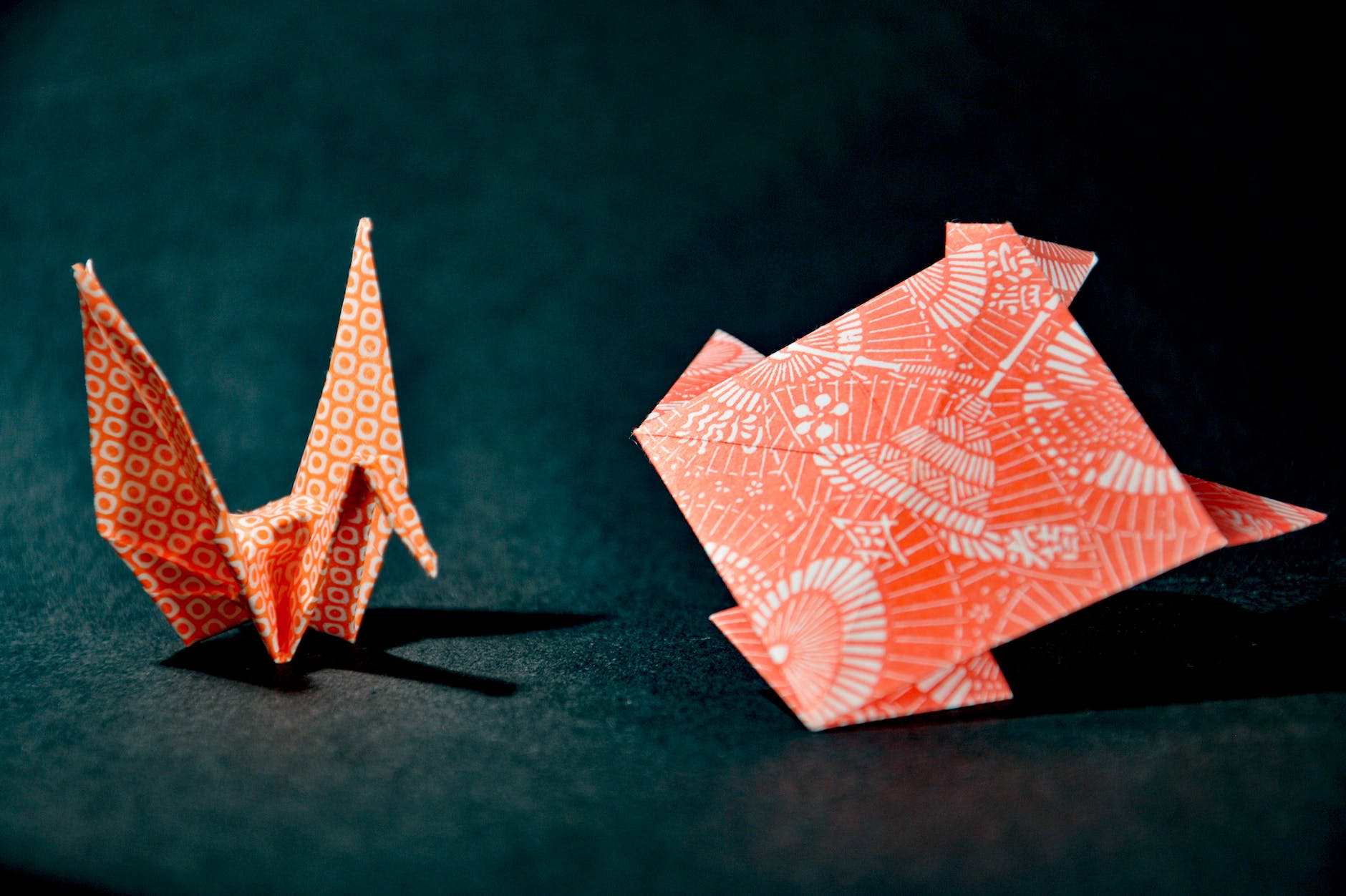
In 3rd grade, some students are asked to read Sadako and the Thousand Paper Cranes. The story is based on the life Sadako Sasaki, a young girl who is diagnosed with leukemia after being exposed to radiation caused by the atomic bombing of Hiroshima. In the book, which differs slightly from her real life story, Sadako’s friend tells her of the Japanese legend of having your wish granted after folding one thousand origami cranes. It is said that “cranes live a thousand years” and folding one thousand paper cranes represent one crane for each year of life.
Cranes don’t actually live a thousand years, but the saying is meant to be poetic and symbolic in nature and means longevity, health and good fortune.
When I read this book to my daughter, we decided it would be fun to try and fold one thousand cranes. That is, I thought it would be fun. Perhaps it’s the simplicity in folding paper, perhaps it’s that the finished product only takes about 3:00 minutes on a good day, and, perhaps it’s because when I traveled to Japan as an athlete, I loved everything about their culture.
The patterns of fabric, the cherry blossom trees, the mountains and the bustling city of Tokyo all hold memories and intrigue. One thing that makes folding origami fun, is choosing the paper. Some paper is a solid color; it’s slightly thinner than standard printer or notebook paper – this is called kami and is the most well known kind of origami paper. Handmade Japanese paper is called washi paper. Washi paper is usually single-sided with a pattern on one side and white (or off white) on the other side. This paper can be a bit rough to the touch and sort of mushy, or maybe pulpy is a better explanation, but it folds incredibly well and you get a beautifully finished product. The last kind of paper is metallic. It’s shiny metallic on one side and white on the other side. You can fold cranes or other origami with any of these papers.
For me, it’s as much about selecting the paper as it is about folding the crane. The more unique the pattern, the better. Packs of paper usually have the same four or five patterns and each pattern will have three or four color-ways. So there’s maybe 20 pieces in one pack. Looking and shopping for unique origami paper at art supply or Japanese concept stores is an addicting endeavor.
Folding cranes keeps my hands busy and my mind still. The perfect combo for an over-thinker.
So why fold paper cranes? Athletes (maybe this is you) and coaches (or you) are always thinking. We are constantly looking for ways to optimize or improve or make better. This is super cool because it does lead to better and better usually feels pretty good; but we can optimize to a fault. During some of my coaching years, folding cranes helped me from over-processing or over-thinking the simple stuff: a lineup, a practice plan, a frustrating loss, team dynamics that feel off, or, even my life off the court.
Folding became a practice I did during the thick of a season. I folded early in the morning (one or two cranes) before training as a way to remind myself of the simple things – like, my hands are capable of making beautiful things, or, it’s cool to make and produce something that no one else will see just for my own enjoyment. If I had more time, say on a plane headed to Boise State, I’d bring a bag of paper and fold cranes instead of being on my phone. On one flight, I folded over 30 cranes and gave one to a flight attendant who seemed to have been having a very long day. A simple paper crane brought a smile across her face.
The paper crane folding life seized me sometime during the summer of 2020, and I have 805 beautifully colored cranes to date. Some days I fold more than other days, but mostly, folding cranes keeps my hands busy and my mind still. The perfect combo for an over-thinking, former athlete with a very busy mind. While one thousand is the goal, I’ve never told my self I have to be done in a certain amount of time. Origami, like gardening, is about the process. It is about the beauty in each crane or each lesson. It’s about a story of a Japanese girl who wanted to live through her disease long enough to fold a thousand cranes and make her wish.
And, I guess I’ll make a wish when I finish.
(I hope this post inspires you to look up Sadako’s story, to read Sadako and the Thousand Paper Cranes (based on a true story), or even to begin folding origami. The information about paper came from paperjade.com and has a wide selection of paper and information about origami).
Coach Tallman has been involved in high performance sports all her life. As an athlete, Priscilla played at the University of Georgia and earned 1st team All-Conference for all four years, including SEC Freshman of the Year and SEC Player of the Year. She also earned 1st Team All-America honors her junior and senior years at UGA. She went on to play on the USA National team, USA World University Games and professionally in Europe. In 2006, she was inducted into the prestigious Georgia Athletics Circle of Honor for excellence in representing her sport and the University.
Coach Tallman has also coached at the high school, club and collegiate levels as a coach and has worked with every level of sport, including professional volleyball athletes as a mindset and mental performance coach.
She combines her knowledge of Sport Psychology principals and her education in Clinical Psychology to bring increased performance as well as education and resources for mental wellness in student-athlete populations.
She has an undergraduate degree in Psychology from The University of Georgia and a Master’s Degree in Clinical Psychology from Vanguard University. Her “30 Day Champions” Journal was studied and researched by graduate students from The College of Health Solutions at Arizona State University in Spring, 2022 and has been used by over 1,000 athletes, coaches and parents.
In 1991, the year I graduated from high school and started my collegiate athletic career at the University of Georgia, Dan Gookin wrote and published the very first “For Dummies” book, DOS for Dummies. Shortly thereafter, Windows for Dummies was published; and, if you didn’t know, now you do, over 1,600 titles of Dummies books have been published in the last 32 years.
But, you’re no dummy. You, are an athlete.
Think of this as my tribute to the Dummies series, but for athletes. Athletes, not dummies, tend to think of every endeavor as something to improve, something to master, something (dare I say it aloud) to win.
Yes, even an innocent hobby like gardening can be taken from a simple thing of enjoyment and turned into a full blown, raised bed, vegetable and cut garden extravaganza. As a former athlete, with control issues and a competitive nature in remission, gardening teaches me patience for myself and others. Competitive athletes don’t have a lot of time to slow down and watch something grow. There’s work to do, records to break, stadiums to fill, and, you work and travel too much to really take care of something other than yourself – it is what it is.
Here’s a few things for those athletes brave enough to grow something other than yourself. I promise, even if you kill off a few seedlings in the process, it will teach you something.
WHAT I LEARN FROM SUNFLOWERS: Sunflowers are my favorite thing to grow. They are hardy, almost always make it from seed to sprout to full blown gloriousness with very little tending to. It’s the beginner outdoor plant for any athlete looking to feel successful in your gardening practice.
Sunflowers have lots of super cool lessons too; sunflowers face the rising sun (that’s the east). So, when you plant a cute little sunny in a patch where it receives morning light that’s where it will face. I once planted a whole patch full of sunnies and every single yellow and brown beauty stood at attention to the rising sun! I use this analogy in my coaching: when we know where to face first thing in the morning, we are prepared for whatever adversity or conflict comes our way. Where are you looking first thing? Is it in the direction of something nourishing? Is it something or someone who brings brightness? Want to see something amazing, plant a sunflower and watch her show off.
I love @anya_thegarden_fairy for all things flowers, lavender, and, my latest endeavor into hopeful propagating. I’ve also recently started following @sun_flower_steve for all things sunnies.
VEGGIES, ROOTS, HERBS: All you need to know about this category is that I’m drying my own basil, thyme, rosemary and oregano to give as Christmas gifts. That’s right, I’m gifting my dried plants to people. Herbs, lettuces, tomatoes and most rooted veggies are slightly harder to grow than sunflowers, but not my much. It’s like adding strength and conditioning to your skill training. You may experience a bit more frustration in the process, but, you will make the garden gains. Most table herbs and spices are also super hardy, and get really big – which makes them fun to grow.
Rooted veggies like carrots, radishes or beets show you they are doing their job by putting up really good numbers (or leaves, I guess). You know something is happening, but you can’t see what is happening. Once the top of the root starts to pop up out of the soil, you have yourself a winner – I mean, veggie. The real lesson here is that beneath all the glam and glitz of what is seen, there is growth happening underground. Just like us.
@epicgardening is my guy for figuring out why my pumpkins aren’t growing, how to eat from my garden for a month (sooooooo not there yet), and how to make the best of a small space.
HOUSEPLANTS: My favorite houseplant account to follow is @happyhappyhouseplant I started following her after killing multiple houseplants. Not that I really cared too much about chucking them into the trash, but as an athlete, I knew I could figure this puzzle out. As a result, I’ve come to love the process of caring for my houseplants. One thing she said the other day that I loved, like really loved was this:
“The biggest mistake new plant parents make is treating plants like decor. Plants make our spaces pretty but they are NOT decor. They are actually living things!” – Happy Happy Houseplant, Owner, Mandi
If that isn’t wisdom for us all! See, plants are a great reminder that we are all living things. While our leafy friends need sunlight, carbon dioxide and water to photosynthesize and grow, we have human needs that need to be met regularly in order to grow and thrive. Being involved in the growing process of plants reminds me that not every seed will sprout, not every plant will thrive and that we need to not treat ourselves as a piece of decor.
Let me say that another way. Your identity as an athlete isn’t just to decorate a room or a team or for the sole use and purpose of another human being. If you coach or parent young athletes, hear this: your athletes are not there to decorate your ego. They need encouragement, they need to be challenged appropriately, they need to be nourished, they need they need adverse conditions so they can figure out how to stand their ground.
Sports and athletics and even coaching can sometimes make you think everyone needs to be fixed, everyone is qualified to win, we all get to make it to the bigs, or that all our goals should be met. Plants teach you no matter how deep your roots, you aren’t guaranteed to grow or survive the winter (or summer ball).
A FEW NOTES ON MY PLANTS: I started small, with plants that were already potted from the nursery. Each season, each year, I’ve grown in confidence at what is possible with good soil, water, sunlight and a lot of patience. I have planted so many things that never came up and I’ve planted things I had to pull up because they would overtake and choke out the whole area – ahem, I’m talking to you mint. I’ve propagated, I’ve started plants from seed, and, I’ve learned that pumpkins are really hard to grow in a desert. But I keep trying and I keep learning about plants and about myself. It’s hard to be simple after you’ve been a competitive athlete, but I’m trying.
Coach Tallman has been involved in high performance sports all her life. As an athlete, Priscilla played at the University of Georgia and earned 1st team All-Conference for all four years, including SEC Freshman of the Year and SEC Player of the Year. She also earned 1st Team All-America honors her junior and senior years at UGA. She went on to play on the USA National team, USA World University Games and professionally in Europe. In 2006, she was inducted into the prestigious Georgia Athletics Circle of Honor for excellence in representing her sport and the University.
Coach Tallman has also coached at the high school, club and collegiate levels as a coach and has worked with every level of sport, including professional volleyball athletes as a mindset and mental performance coach.
She combines her knowledge of Sport Psychology principals and her education in Clinical Psychology to bring increased performance as well as education and resources for mental wellness in student-athlete populations.
She has an undergraduate degree in Psychology from The University of Georgia and a Master’s Degree in Clinical Psychology from Vanguard University. Her “30 Day Champions” Journal was studied and researched by graduate students from The College of Health Solutions at Arizona State University in Spring, 2022 and has been used by over 1,000 athletes, coaches and parents.
We love a free tiny little jar or jelly or jam (grab a few and stuff them in your backpack for later)
Not all coaching or sports moments are created equally. As someone who recently stepped away from coaching a sport, I have been writing in my journal about things I loved about coaching, but also things – little minor things – that sort of creep up on you as pain points in coaching. Maybe they aren’t so minor after all.
One of those things? Road trip food. See, in coaching, or on teams in general, you have a meal budget (if your team travels by charter or private jet, you can stop reading, this ain’t for you – this is for the real ones – you know who you are). Typically there’s a dollar amount allowed for breakfast, for lunch and for dinner. The amount of the meal starts small for breakfast and increases by dollar amount throughout the day; so, your dinner is the typically the most expensive meal you eat. Most weekends, there’s extra money for snacks and food that you have around for pre/mid/post match noshing, but for the most part you get three square meals a day when you’re on the road.
If you get per diem, you can choose how to spend that money yourself, but that’s not always an option and because athletes are cheap – I was going to say cost conscious, but I used to be an athlete and I was cheap – coaches know it’s not always best to let an 18-22 year old loose with $15. Taco Bell used to be a per diem gold mine where we could order big, but pocket the change even bigger.
One good thing is that mealtimes are pretty close to what seems “normal,” for when to eat, but working around a playing schedule can also be tricky, so you eat when you can. Even if you’re not necessarily hungry.
Breakfast has oft been touted as the most important meal of the day. The people from the breakfast marketing team have done a really great job of pounding this information into our heads since kindergarten. The irony of this meal is that when you wake up at 5:00 a.m. to get to your playing facility by 6:45 a.m. for a match that starts at 8:00 a.m. you may not be super hungry. Still, you choke down the hotel powder eggs, wobbly sausage and maybe some soupy oatmeal if you’re feeling lucky. You might grab a couple bagels, stuff them in a napkin in your backpack with a few free jelly packets for a mid-morning court side brunch. With the lowest budget amount of the day and not a lot of time to spare, you are at the mercy of the hotel breakfast. It saves time and money – two things coaches and athletes with an early morning court call are looking to save.
Maybe the most memorable team breakfast I can remember in the past seven years, was in Florida. We happened to be playing the same weekend as a NASCAR event near St. Pete’s and every decent hotel in the area was booked. We ended up at a hotel with questionable security measures, propped our luggage and any spare room furniture in front of the door, ignored the bloodstain on the window curtains as we drew them shut and hoped for the best. As morning came, we shuffled to the complimentary breakfast room, exchanged our “admit one” carnival ticket for a seat at the table and prayed away the IBS fairy who was scheming over in the corner as she watched her collection of victims gathered in the room.
We all survived and St. Pete’s is beautiful in the Spring.
Looks like we’re out of time, you’ll have to join me another day for lunch, dinner, ordering from the google doc, orders gone wrong, food allergies, lactose intolerances (hey, coach, can you just pull over right here and drop me off?), why I couldn’t have a smoothie and a sandwich, and no tomatoes on anything … ever.
Coach Tallman has been involved in high performance sports all her life. As an athlete, Priscilla played at the University of Georgia and earned 1st team All-Conference for all four years, including SEC Freshman of the Year and SEC Player of the Year. She also earned 1st Team All-America honors her junior and senior years at UGA. She went on to play on the USA National team, USA World University Games and professionally in Europe. In 2006, she was inducted into the prestigious Georgia Athletics Circle of Honor for excellence in representing her sport and the University.
Coach Tallman has also coached at the high school, club and collegiate levels as a coach and has worked with every level of sport, including professional volleyball athletes as a mindset and mental performance coach.
She combines her knowledge of Sport Psychology principals and her education in Clinical Psychology to bring increased performance as well as education and resources for mental wellness in student-athlete populations.
She has an undergraduate degree in Psychology from The University of Georgia and a Master’s Degree in Clinical Psychology from Vanguard University. Her “30 Day Champions” Journal was studied and researched by graduate students from The College of Health Solutions at Arizona State University in Spring, 2022 and has been used by over 1,000 athletes, coaches and parents.
“I don’t want to go to the game,” our son said slouching in an oversized chair in our living room. He was close to tears and fully dressed in his baseball jersey with his catchers bag packed and his cleats still red from the diamond dust of his last game.
It was June of 2020 and little league was just opening back up for makeup games from Spring. After a very confusing and very weird several months, our local little got the go ahead to resume our canceled season despite the less than ideal circumstances (and temperatures) of that time of year.
“You have to go, you made a commitment to your team,” said my husband.
I turned those words in my head along with everything we had adjusted and adapted to in the past three months. The details or specifics of our conversation are fuzzy, but on that day, my son quit little league – and baseball altogether.
QUITTERS. Quitting in the world of sports can be somewhat of a profanity. It’s a hot potato word and no one wants to catch it or be near the one who does. But somehow, this felt different. First off, we’d been living in a sort of pseudo-microcosm since March and had already made some big decisions regarding how our family would navigate the current landscape of a world in a pandemic. Quitting a sport seemed like the least of our worries.
It still felt like a risk to let our kid quit something, but, we trusted that he knew what was best for him in that moment. After all, we ask our kids to share with us and then they trust that we’ll actually listen. Were we going to be parents of our word or would we be offering lip service to a very sad 12 year-old.
And so it was, the beginning of making better choices and listening to what our kids were actually trying to communicate with us; and truly living to the values we had always spoken about in our family.
If you have younger kids, you are likely in the “let them try everything” stage. We did that too. As they get older, however, and have the language to express themselves better, it’s important to listen to what they are telling us. Here are a few things we did and continue to do with each activity we choose. The older they get, the more they can be an active part of this process:
WE REMEMBERED OUR VALUES. Values are the operating systems of families. Whether they are spoken, written or only thought, every family operates off a system of values. It’s how we make the big decisions for our families (financial decisions, education decisions, career, relational and friendship decisions). When we know our values, we can make better decisions.* The same is true for youth sports, especially as kids get older. Knowing your values will help you make a better decision for your child and your family when the pressure of what other families are doing or comparison start creeping in. Or when a coach or club director comes at you with all those promises of grandeur – you know the ones.
Ultimately, we must remember: families create values and character, not sports
*(As a side-note, when we make better decisions, we become more confident. Confidence doesn’t come only from being good at something (that helps), confidence comes from making good decisions and living into your values – yes, even for kids.)
WE EXAMINED WHAT WE WERE PAYING FOR. Repeat after me: “I am not paying for a college scholarship.” You can search up how much colleges are giving for scholarships these days, but I can guarantee it’s not as much as you’re paying for your club experience – and, we’re not talking dollars here. Being on a team requires an investment of our time, our energy, our sleep, our nutrition, our family time, etc.
Sports, yes, even youth sports, are a business. That isn’t a bad thing, it’s just the thing. Instead of becoming emotionally invested in the “idea” of your kid as an athlete, become a consumer of what you are buying for your kid. When what you’re paying for aligns with what you want from your kids’ sport experience, everyone wins. I think we all know what it looks like when a parent is more invested than the kid.
WE QUESTIONED WHAT WE WERE BEING SOLD. “If you don’t do travel ball now, you’ll never get put on a team and you’ll be behind and miss your spot in the future.” You can say the same for soccer, volleyball, tennis, golf or any sport, really. We had to go back to our values and our finances regularly to block out the noise of the club sport machine. We felt that pull. We felt confused. We were afraid of missing our kids one and only chance for a team.
Ultimately, we listened to what we knew worked for us and we listened to our kids. They have voices and they know what is working for them and what isn’t. We may not always get it right but we can always dust ourselves off and try again. (I’m fully aware we are a family is in a position to choose, many families do not have these same choices. In addition, some sports have really difficult and expensive access points).
THAT’S JUST A HOBBY. When our son finally quit the last of the organized sports teams (club soccer was the last one), there was a sadness for him and for us. Being on a team is a wonderful thing. Practicing and working together for a common goal gives us purpose, resilience and a sense of belonging. But we noticed he was more interested in other non-traditional sports that had teams, coaches and training groups, but were more individually focused. Sports, I had considered hobbies because of my own background.
And, eventually his hobby became his sport.
NOT A LEGALDISCLAIMER: I love sports. Still a huge consumer of sports and sports culture (and shoes). I have coached and remain in the sport as a mental performance and mindset coach, parent educator and author of resources for athletes. Looking at your values isn’t anti-sport, it is a tool to help you make better decisions for your kids and your family.
Coach Tallman has been involved in high performance sports all her life. As an athlete, Priscilla played at the University of Georgia and earned 1st team All-Conference for all four years, including SEC Freshman of the Year and SEC Player of the Year. She also earned 1st Team All-America honors her junior and senior years at UGA. She went on to play on the USA National team, USA World University Games and professionally in Europe. In 2006, she was inducted into the prestigious Georgia Athletics Circle of Honor for excellence in representing her sport and the University.
Coach Tallman has also coached at the high school, club and collegiate levels as a coach and has worked with every level of sport, including professional volleyball athletes as a mindset and mental performance coach.
She combines her knowledge of Sport Psychology principals and her education in Clinical Psychology to bring increased performance as well as education and resources for mental wellness in student-athlete populations.
She has an undergraduate degree in Psychology from The University of Georgia and a Master’s Degree in Clinical Psychology from Vanguard University. Her “30 Day Champions” Journal was studied and researched by graduate students from The College of Health Solutions at Arizona State University in Spring, 2022.
Recently, I was filling out paperwork for my child’s school physical – better known in the sports world as the Pre-Participation Evaluation (PPE). On the back of page two was a form titled “Patient Health Questionnaire Version 4.” This page asked me to rate four questions from “not at all” (a score of zero) to “nearly every day” (a score of 3) regarding my child’s feelings about the following: anxious, on edge, losing interest or pleasure in doing things, feeling down, depressed or hopeless or an inability to stop worrying. There was a short paragraph below the questions explaining how to add up our score. If we scored three or greater, my child could have anxiety or depression.
A few years back, questions such as these weren’t on the PPE, and, so it made me think. Now that criteria for anxiety and depression are on PPE’s for pre-season (this may vary depending on what state you live in) will this help identify athletes who may need additional support or resources? Will it help or hinder their chance of playing?
For this article, I asked four athletic trainers about their experience with the PPE, their interaction with athletes who experience mental health issues such as anxiety, depression or eating disorders and found some great published research on the subject (I’ve linked them below). Their experiences vary, the state they practice varies and factors relating to demographic or socio-economic factors may play a role in how their practice responds to mental health. For reference, when I use the term “student-athlete” I am referring to a high school or collegiate athlete (in any division).
How it Works?
“Athletic trainers are often the first point of contact regarding health information for student-athletes, which may provide them with a unique perspective and insight into the individual – and community – outcomes.”
Beaupre, Meske and Buckley, Journal of Athletic Training, p. 141.
In a perfect world, an athlete tells their coach, athletic trainer or strength and conditioning coach (s/c’s get a lot of face time with athletes) they are struggling with anxiety or sadness or have a performance block. The coach will then (knowing their appropriate channel to report) have a conversation with the athlete and athletic trainer and the referral is made. In most cases, the referral will be to a sports psych, the counseling center or school counselor – in some cases athletes may have their own therapists/counselor. The athlete will then get the help they need and return to play with a plan to support their mental health and ongoing wellness.
Unfortunately, it’s not a perfect world. Some possible reasons might be:, communication can be unclear, reactive or not happening at all, relationships between athletes and coaches can be complicated or athletes may not disclose because they don’t want their playing time affected or to be removed from the field of play for mental health reasons. Some programs do this better than others, but here is quick view of the two main referral sources for high school and collegiate programs.
The Counseling Center Referral
“Communication does not happen unless we are made aware of a problem [from coaches], then we will get the counselors at the school involved as well as all needed parties. It is a very reactive environment and not proactive at all.”
Athletic Trainer(21 years)
While the counseling center referral is likely the referral most athletes need for clinical help, it is the least likely to be used. For many reasons, including funding, accessibility, timeliness of appointment and availability of the athlete due to schedule conflicts, the counseling center gets used far less than it should.
In a study conducted by Beaupre, Meske and Buckley in the Journal of Athletic Training, athletic trainers (AT’s) estimated that 32% +/- 23.5% of student athletes had expressed feelings of sadness, anxiety, depression or suicide in the past year (2022). This aligns with a study done in May, 2022 that reported that 38% of female athletes and 22% of male athletes felt “mentally exhausted constantly or every day.” This may not seem like a win, but it’s progress. In years past, the numbers athletic trainers reported were significantly higher than the numbers self-reported by athletes in similar studies. Which suggests that perhaps the stigma surrounding mental health is improving even if communication still seems to be a work in progress.
But one more thing might be contributing to why athlete’s are hesitant about using the campus or school counseling center for mental health support – athlete identity.
Most athletes are firmly planted in their identity as an athlete; it’s a place to belong and provides an identity, purpose and privilege on campus. Going to the same place for counseling that “regular” students go is recommended and often the only resource for athletes in high school or college, but athletes don’t see themselves as regular people which may create an unspoken barrier. In addition to identity and resistance, sometimes it could take a week or longer for an athlete to get an appointment, so while a referral has been made, athletes still have to make and keep an appointment.
The Sports Psych Referral
When athletes have performance blocks, sometimes – not all times, there may be a mental health issue pushing performance related anxiety or depression to the surface. Many reasons contribute to the prevalence of anxiety and depression (the most common mental health concerns along with eating disorders) in student athlete populations, but among the top reasons: perfectionistic tendencies, the need to be consistently great, family and friends who may not understand the pressure, coaches who have mental health issues of their own or have trouble relating, social media or media in general, comparison. Less frequent diagnoses include PTSD, OCD, Bipolar and personality disorders or non-suicidal self injury (NSSI) or cutting.
“Relationships are key so that medical providers get to know their student athletes. They can realize when an athlete is struggling both mentally and physically. Most coaches are focused on the game itself and may not realize when an athlete is having issues.”
Athletic Trainer (24 years), MEd, SCAT, ATC
One of the first referrals for performance related issues is the sport psych referral. While Sports Psychologists help athletes work through things like performance anxiety, self-talk, breathing and visualization techniques to improve performance (and off the field habits), most Sports Psychologists are not Clinical Psychologists and cannot perform therapy or counsel an athlete with a clinical issue. Many times, the Sports Psychologist will still have to refer to a Clinical Psychologist (counseling center) for the athlete to work through the underlying issue. Note: Clinical Psychologists and Sports Psychologists have different educational and certification tracts and do their intern and trainee hours with different populations.It’s important to understand these are different practices and treat different things.
The sports psych, however, is an excellent resource for those teams and campuses who are able to fund this role. As they work through performance issues, athletes form trusting and open relationships with someone who will listen to them for who they are outside of sports and help them work through difficult things. This relationship requires vulnerability and authenticity, which is an important for healing and growth.
“In my opinion, dealing with athletes – especially at the elite competition level (youth, adolescent, college or pro) – they are not supposed to show emotions that affect their performance and are often scared to be honest with someone [a coach or trainer] when they are struggling”
Athletic Trainer (9 years), MS, AT, ATC
Because vulnerability is not usually a skill trained on the field, it is likely a big reason why in sport situations, the easiest thing to fix is the performance issue instead of a clinical issue. When the performance issue resolves, an athlete plays better and feels better. Perhaps only momentarily, athletes, coaches and family all breathe a sigh of relief because the complicated, scary thing has been taken off the table. Working through a mental block in performance may seem easier than working through an eating disorder, anxiety or depression, but just because performance improves does not mean healing or growth has happened at the root level.
Athletic Trainers -The Ones Who Know Things
“Athletic trainers are often the first point of contact regarding health information for student-athletes, which may provide them with a unique perspective and insight into the individual – and community – outcomes.”
Beaupre, Meske and Buckley, Journal of Athletic Training, p. 141.
When I was coaching Division 1 Beach Volleyball as the volunteer assistant, I had the privilege of rooming with Athletic Trainer when we were on the road. I got to learn quite a bit about what the trainers do on a daily basis for our teams. When athletes need treatment on the road, and let me tell you, if you have a good one, they are the real deal. AT’s really are the front line for all things minor, major and everything in-between to get athletes back on the court. In my sport of beach volleyball, athletic trainers do their best to keep athletes safe, get them back on the court within a reasonable timeframe (sport, admin and coaches all play a role in this too) and in general talk all kinds of life with them on a regular basis.
For the most part, athletes trust their trainers. They may not always like going to treatment or having a longer warm-up, but if an athlete knows what’s good, they will listen. Because athletes with minor or major injuries are in the training room often, trainers know things that coaches might not know. There’s just one gap … mental health education for athletic trainers is not standardized.
A recent study reported that “there are large percentages of individuals [AT’s] who self-reported not learning about many mental health disorders as part of their professional programs [and] should be of concern to the Commission on Accreditation of Athletic Training Education (CAATE),” (Ostrowski et. al., Moravian College, Sports Medicine & Rehabilitation Centers, June 2022, p. 13).
“Increased emphasis on mental health recognition and referral is needed in professional athletic training education, and should be emphasized as part of continuing education requirements.”
If it seems confusing or like I’m talking in circles, imagine how it feels to an athlete who is struggling with depression, suicide ideation, panic or anxiety attacks or any other mental health issue. Confused or overwhelmed are two feeling that come to mind.
So what do we do from here? We need to understand first and foremost, in youth sports we are the adults and we can advocate for our athletes. In the past ten years, athletes have increased advocacy at all levels of sport: Michael Phelps, Naomi Osaka, Simone Biles, Ebony Nwanebu, Aly Raisman, DeMar DeRozen, Amanda Beard, Kevin Lore, Justin Duchscherer, Ricky Williams and more. What hasn’t increased is coaches certifications, education or requirements to perform coaching duties.
Here are a few ways we can do better for student-athlete mental health:
increase education and certification for coaches from youth-collegiate sports
increase communication between Athletic Trainers, Coaches and S/C
More coaches advocacy for student-athlete mental care
Know your referral sources and which on to use at what time
Meet regularly with athletes and talk about non-sport related things
Get curious about how you can better educate yourself as a coach and what admin staff you can ally with to make small changes. Everything helps
Organize a coaches group/meeting to discuss challenges in this area
Several years ago, I wrote a post about identity and self worth in athletes. Since then, so much has changed in our world and in my life. With new context and thousands more coaching hours under my belt, I decided to update my thoughts on these concepts.
“I AM AN ATHLETE”
Michael Phelps is an Olympic Gold Medalist.
Simone Biles is a gymnast.
Naomi Osaka is a tennis professional.
Those labels, those titles are identities. While there is a range even in those titles, athlete identity is in part defined by how you perceive yourself and how others perceive you. This can be a helpful part of your sports experience because when you play sports, there’s built in identity, community, friends and support for any particular team you play for – from little league all the way to the bigs.
Identity is an external label. It is what you do or what team you belong to.
As a coach (with a background in psychology) I love the work of developmental psychologist, Erik Erikson. His 8 Psychosocial Stages of Development have helped me build developmentally appropriate resources for athletes of all ages. Three of his stages represent the years from age five to age eighteen. Stage 5, “Identity vs. Role Confusion” says this:
Simply put, adolescents and teens are looking for an identity. They are also looking for peer approval, belonging and acceptance. Athlete identity (or any group your teen identifies with) actually serves a specific purpose for the psychosocial development of a child. This stage hits some big physical and emotional milestones too as it begins around age 12 and ends around age 15.
During this time, your child is also exploring their own personal values, beliefs and goals. So, here’s where the work begins – because without a foundation of values, identity can be the only thing an athlete clings too and that can be a slippery slope if it ever gets taken away. Spoiler alert: at some point, ever athlete’s journey comes to an end.
“I started thinking about who I am off the floor. I started searching for what success is outside of basketball. If I didn’t play sports again, what could I possibly do that still brings value to the world and to my family?”
Athlete values are the internal operating system by which we live our lives.
Our values are defined by (but not limited to) culture, religion, ethnicity, community, sport played, family, country of origin, city, state, political climate – so you can see, values are not easy to come by and very rarely are they spelled out and defined.
Values are internal.It is who you are as an athlete.
Here’s why value work and formation are so important. We make decisions based on our values every single day. From what we wear to how we speak and act in public or private, our values drive decisions, thought and behaviors. If you know your values, you make better decisions for your life and your goals. If you do not know your values, you are at the mercy of whoever you are around to help define those for you and guess what, your decisions and goals might not align with what you actually believe, but what someone else believes.
“For the longest time I thought asking for help was a sign of weakness because that’s kind of what society teaches us. Well, you know what? If someone wants to call me weak for asking for help that’s their problem. Because I’m saving my own life.”
Michael Phelps
Michael Phelps, Simone Biles and Naomi Osaka have all come forward with testimonies about their personal experience with anxiety, depression, trauma, social anxiety; and many more professional and collegiate athletes are coming forward with their own personal stories and journey through the murky waters of sport and mental health.
While there are some amazing organizations like “I love to watch you play” and “Changing the Game Project,” who are creating resources and better ways to do sport, there is still so much work to do at so many levels and so many kids who are not getting this message. Talking about the differences between our identity and our value system can be a way to open a conversation with your athletes and teams about what matters.
WRITE IT DOWN
Here’s a little exercise to do on your own or with your athlete.
Download my FREE RESOURCE “Identity Versus Values” and keep it handy. You can either print it out or screenshot it for reference.
Find a list of values (you can search one up or use this one). Print out a copy – yes, pen to paper because it’s good for your brain – and circle all the values that you feel best describe you.
Now the fun begins. Select your top FIVE values out of all the ones you circled.
These are the ones that matter most to you – notice any similarities to your sports team or your family. Notice any differences. You may not begin to live out or make decisions off these values (and some may change as you grow and learn) but now you have values to work from.
Write this down: I am an athlete who is (fill in one of your values from the list) and keep it somewhere you see everyday like your bathroom mirror or your nightstand.
Priscilla Tallman is a Mindset and Performance Coach in Phoenix, AZ. She has an undergraduate degree in Psychology and graduate degree in Clinical Psychology. She is an 2x All-America volleyball player from the University of Georgia, SEC Freshman and Player of the year and was inducted into UGA’s prestigious Circle of Honor in 2006. She has played on the US National Team and played one season of professional volleyball in Geneva, Switzerland. She has coached at the youth, high school, club and collegiate level.
She has written two nationally-published performance journals.
A few weeks ago a thought popped into my head “I wonder whatever happened to that article I pitched to … ?” So I hit the command/F keys and searched my email for said inquiry.
Found it.
Sent September 16, 2020. Opened September 16, 2020. No response – and I guess I forgot to follow up as well – as it goes with writing and inquiring. Lots of no’s. Even from those I’ve worked with or written for in the past. It’s a tough gig sometimes and the pay isn’t great, often there’s no pay at all.
For a second I thought “I’ve been ghosted.”
Ghosts and Gaslights
By the time this post runs, these two terms will already be gone – you know, like ghosts – without warning and because it’s your fault and you are crazy. If you don’t know already ghosting refers to a person who “cuts off all communication with their friends or the person they are dating with zero warning or notice.” No texts, no phone calls, blocked on social. Gone. Like a ghost.
Gaslighting is a term used for someone who uses manipulation or intimidation to make you think what you know about a situation is wrong, that you are imagining things about a relationship or situation and to make you doubt yourself, your relationships, your situation – your sanity. It’s abuse.
So, who cares about these words and why do they matter for sports?
Social Terms Aren’t Always Relevant in Every Situation
Example 1: Sometimes I misplace my keys. I know where I put them. I KNOW where I put them, someone else MUST have moved them. The song and dance begins as to who moved them, why it couldn’t have possibly been me who moved them and at some point my husband says “maybe you put them somewhere else.” It’s all fun and games and just as the tension hits a peak, someone other than me finds my keys – in my closet, or still in my car or … you get the picture.
What my husband gaslighting me? Nope. It’s life. I’m not crazy, I am over booked some days though and things get missed. I own that (sometimes).
Example 2: Sometimes, I pitch an article to a publisher and editor or someone who needs content. I’ve worked with many editors and people who need writing. Recently, I’ve pitched a few articles on mental health and athletes, research ideas to people who asked me for research ideas and I’ve been working hard to sell journals to sports teams, coaches, athletes, organizations looking to build culture through journaling.
I’ve pitched and had more conversations – with people I know and have worked with – than I can track or remember. Most of them don’t get back to me and most of the time I forget I’ve even pitched because in the writing business there are a lot of no’s. A LOT.
So is the publishing industry ghosting me? Nope. There are some jobs and teams (most of them actually) where the purpose is to get as many inquiries (or tryouts) in order to find the best content (or athlete) for the gig. It’s simple.
Unfortunately, these terms aren’t necessarily simple concepts and when we put them in a context that is simple, it complicates things.
Don’t Complicate Simple Things
I’m not saying ghosts and gaslights don’t appear in sports. We’ve seen entire industries shaken because of the manipulation, abuse and trauma caused by adults who convinced families and athletes that they are crazy because of an abusive, manipulative adult who has used their power in the worst ways imaginable.
We know coaches and sports teams regularly have to make decisions that will cause people to think they are ghosted or forgotten about (this happens to me every day in my business). Sometimes I get my feelings hurt and it stops me from pursuing things I love or makes me place that next email in “draft” for a few days while I muster up my courage again to hit send.
Most times I remember that I’m not the only person pitching ideas or selling content. And that if I really want to share my message, I can.
A Side Note on Resilience
This week I spoke to a parent with a child in sports. They shared an very difficult experience their child was going through on their team. “As a parent, a coach and as a person with experience in psychology, what would advice would you give in this situation?”
I get calls, texts and have conversations like this often. As long as there isn’t any physical harm or emotion/mental abuse (because if there is, GET OUT, no sport is worth that bargain with your child) I respond like this:
AS A PARENT: You are a consumer. You are paying money in exchange for a product. Yes, a product. Not your kids hopes and dreams, not a D1 scholarship, not an Olympic gold medal. The product is there to work for you, your family and your kid. If you are getting fed promises about the things above and you want to pay for that, that is on you. Otherwise, be very clear about what you are spending your money on. If it works for you, your kid and your family – then let’s go.
AS A COACH: Ideally, directors and coaches are doing their best to create the best product for your child. But they are human. Things get missed. If a club or a team has multiple groups and has to manage all those groups, their staff, a facility, all business related issues (e.g.budget, fundraising, uniforms, purchases), programs, practice planning, athletes, etc. they may have the best intentions and will still miss things. Again, aside from physical/mental /emotional abuse, go back to “what am I paying for?”
AS AN M.S. IN CLINICAL PSYCHOLOGY: I always encourage parents to speak with their child about these things. How much pain is this situation causing your child? Is the situation a hard lesson or is it abuse? Has your child’s demeanor or personality changed because of this situation? Does your child want to quit their sport because of this situation? If the situation is more than a “sports lesson” assess the situation and make the best decision based on what you learn from your child. No sport, no scholarship is worth mental, emotional, physical abuse or harm.
Look, there are lessons to be learned in sports. You know your child best. Try to help them become the hero of their story. They have choices, you have choices. They have a voice, you have a voice.
Priscilla Tallman is a freelance writer in Phoenix, AZ. She has an undergraduate degree in Psychology and graduate degree in Clinical Psychology. She has written for FloVolleyball, Volleyball Magazine, The Art of Coaching Volleyball, Sweat RX, Gorgo Fitness Magazine, CrossFit Fury, The CrossFit Games and OPEX Fitness. She written two performance journals
She is an 2x All-America volleyball player from the University of Georgia, SEC Freshman and Player of the year and was inducted into UGA’s prestigious Circle of Honor in 2006. She has played on the USA National Team and enjoyed a season of professional ball in Geneva, Switzerland and on the beach. She has coached at the youth, high school, club and collegiate level. She is married with two children and currently coaches performance and mindset journaling to youth and college athletes and coaches.
One of my favorite quotes of all time comes from a book I’ve devoured (twice), notated and referenced over and over again – “Grit, The Power of Passion and Perseverance,” by Angela Duckworth. The full quote is eight words, but my favorite three are these “effort counts twice.”
As much as talent counts, effort counts twice.
Angela Duckworth, GRIT
When coaches look at a training group or session, we try to create the best possible environment for growth and grit; we design a session that will push athletes to the edge of their comfort zones while also creating opportunity for them to learn, acquire new skill, train a developing/current skill and give them chances to compete under pressure. We are trying to create pressure situations and we expect effort.
Here’s the tricky part though – external pressure from the practice design is only one part of the needed pressure to create effort. Athletes are used to performing for their coaches, for each other, for their parents but many of them need to be trained in how to compete or perform for themselves. And that internal pressure is what creates the effort necessary to not only grow and learn, but to prepare for the pressure that comes in competition and the knowledge of what to do with it when it shows up.
Most athletes are inherently aware that the reason they train is to get better, but many of them are not equipped to handle more than the learning part of sport when it comes time to cash in their training and use what they know on the competition field.
Pressure is a Privilege
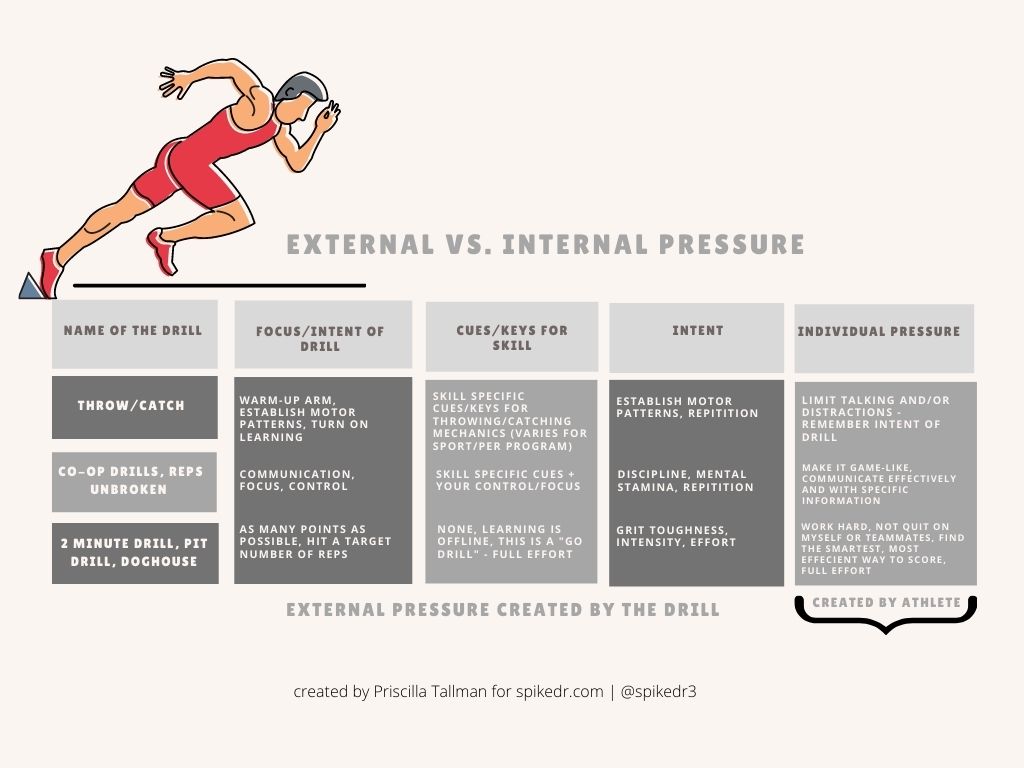
In order to understand what external vs. internal pressure looks like in a particular training session, we need to blend the coaching and athlete world for a second. The chart below shows a few drills from warm-up to cooperation drills to buy-out or “doghouse” or warrior drills. In the first column are drills created by the coach to create external pressure on the athlete. In order for the athlete to take responsibility and ownership of their training time or in any particular drill, they can create their own internal pressure to get the most from it.
EXTERNAL PRESSURE is created through focus, keys/cues and intent of the drill. INTERNAL PRESSURE is added by the athlete. For training to effectively transfer into effort on the competition field, both external and internal pressure should be present. Can it work without the athlete creating internal pressure and relying on the external pressure alone?
Yes.
It works all the time. But as athletes begin to take their sport more seriously or the level of competition rises, they begin to take on more responsibility for their outcomes. The idea though is to get athletes to own their training time so that when pressure is created by a drill, a tough opponent, an adverse situation in competition, an athletes effort is not affected. Pressure prepares us to compete. Therefore, we need to practice being in pressure situations instead as often as possible. Training or practice creates these opportunities.
Creating Pressure, Taking Responsibility
This isn’t a call to arbitrarily put more pressure on athletes for the sake of having a better practice or creating desirable difficulty – though both will likely happen. The goal here is to begin placing responsibility on the athlete as they progress through the sport. Why though? Because it’s their journey. As coaches we guide that journey. As parents, we support that journey and as athletes, you live that journey. When athletes don’t take responsibility of their journey (within developmentally appropriate means), the likelihood of burn out is greater.
What seems to be on trend the past decade or so in youth sports is medal counts, number of athletes committed or signed and flashy drills or workouts that don’t translate to competition. What seems to not be trending? Those club teams posting the same athletes de-committing, entering the transfer portal after one season or the ones who come home after a year because they were chasing someone else dream.
See, effort isn’t going to show up just because someone is playing a sport or chasing the coach or parent’s dream. Effort comes as a result of the right external stimulus for growth (the practice plan) plus the internal drive and pressure (making that practice work for me) to meet the demands of that stimulus. When these two meet, kids don’t just get better at sports, they chase their personal and team goals too.
Priscilla Tallman is a freelance writer in Phoenix, AZ. She has an undergraduate degree in Psychology and graduate degree in Clinical Psychology. She has written for FloVolleyball, Volleyball Magazine, The Art of Coaching Volleyball, Sweat RX, Gorgo Fitness Magazine, CrossFit Fury, The CrossFit Games and OPEX Fitness. She written two performance journals
She is an 2x All-America volleyball player from the University of Georgia, SEC Freshman and Player of the year and was inducted into UGA’s prestigious Circle of Honor in 2006. She has played on the US National Team and enjoyed a bit of professional ball in Europe and on the beach. She has coached at the youth, high school, club and collegiate level. She is married with two children and currently coaches performance and mindset journaling to youth and college athletes and coaches.
Bow tie passing for volleyball (or hockey), over the net cooperative pepper, Rondo, passing shuttles or run plays in basketball … no matter what you call them, ball control or cooperative team drills in sport are commonly used to develop sport specific skills, focus and create good mental patterns and brain grooves that make it look like this stuff comes easy. It’s the kind of drill that seems pointless or boring, but it’s packs a punch – it’s a drill where athletes must cooperate to complete.
I said COMPLETE, not compete, just wanted to make sure y’all saw that right.
From a mindset standpoint, however, these drills train a variety of mental and performance skills too. Take a look at these powerful benefits of cooperative drills that may have you adding them to your practice plans to train mental and performance skills as well as the ever-sought after and sometimes elusive ball control.
RESILIENCE – In every cooperative drill there is a moment of failure. Actually, multiple moments of failure. Some days, oh so much failure. With each failure or shall I call it “incomplete” round, the drill seems further and further out of reach and athletes (and coaches) have to figure out how to adjust, adapt or change what they are doing in order to make the drill work. It could be a communication issue they need to iron out, could be a team dynamic, could be the weakest player continuing to end the drill, regardless of the point of failure, it’s what they do and how we frame the drill as coaches that matters. It’s the resilience piece we are looking at specifically. Cooperative drills have something to teach every athlete from the most skilled to the beginner and when we are paying attention, they teach us coaches a lot too.
COMMUNICATION – One of, no THE MOST IMPORTANT part of any co-op drill is communication. When co-op drills go quiet, it’s never a good sign. These drills train both self and other communication. Self-communication is how each individual athlete speaks to themselves, it’s the mental process of adjusting and adapting on the fly after a mistake or when trying to hold the drill together as a leader. It’s also the negative, self-sabotaging talk athletes do when they focus only on their own performance instead of the effort or learning of the whole group. What my athletes say to themselves is important.
Other communication is what I say to the team as the drill is happening. Narrating or talking through a drill as a commentator keeps our critical and judgy part of our minds busy. In “The Inner Game of Tennis,” W. Timothy Gallwey introduces us to Self 1 and Self 2. Self 1 is the judgy, polarizing self who says “that was bad” and Self 2 is the self who has trained thousands of hours of reps and hasn’t forgotten the skill they are working on since yesterday, but often gives into the pressure of Judgy Self 1.
Regular use of co-op drills lets athletes know there’s another shot at completion on another day and another chance to practice communication – side note, they might not be thrilled at the next opportunity, but they are learning and improving. Another side note, there may be a point in the drill when the communication becomes whiny, players yelling at each other or just plain mean. Stop the drill, reset and have them begin again. Good communication leads to confidence and confidence helps us perform better.
“Coaching is unlocking a person’s potential to maximize their own performance. It is helping them to learn rather than teaching them.”
Timothy Gallwey
VARIED PARAMETERS – whether you go for time, reps or break them into smaller teams to see who can complete the drill first, varying your co-op drill parameters will help create different stimulus and different learning depending on the day. There will be days that you want to train persistence and determination and, so, you just go as long as you need to complete the rep scheme. Some days you give them a rep scheme, but you need to get to other things in the practice, so you give them one last ball and call time even if they don’t complete the drill. When you vary the parameters for completion, it keeps your athletes in the sweet spot for learning. Time sensitive co-ops create a totally different tension than reps only co-ops. Decide your intent for the drill and what skill you are looking to reinforce and use that parameter to promote their learning.
CREATING SYSTEMS FOR CONFIDENCE – I’ve quoted him before and I’ll quote him again – in his book “Atomic Habits,” by James Clear he talks about creating good systems as a way to create new habits. He says “You do not rise to the level of your goals, you fall to the level of your systems.” Without good systems, your team goals are going to be pretty hard to achieve and if those goals include winning, you will need a good dose of confidence. Co-op drills create good systems and draw out dynamics through mental exhaustion and failure – these dynamics also regularly appear in the heat of competition. When we practice the point of failure plus mental fatigue and have systems in place to overcome them, WE BUILD CONFIDENCE.
“The primary reason the brain remembers the past is to better predict what will work in the future.”
James Clear, Atomic Habits
JOURNALING – If you want to take it one step further, you can have your team do a five minute journaling exercise about their co-op drill experience after practice. Here are the questions I’ve used:
1. What worked?
2. What needs improving?
What stopped your learning?
I’ve used this exact format as an exit ticket for the whole practice, but you could specify it to the co-op drill since most days co-ops are not easy to complete. The exit ticket has been used by many coaches and classroom teachers, it’s not mine, but it’s a great practice.
There are many resources out there for us to continue learning and educating ourselves as coaches (I’ve included a couple books in this article), so no matter where you are on your coaching journey you can be encouraged that we are all somewhere on the continuum of growth. Happy coaching!
Priscilla Tallman is a freelance writer in Phoenix, AZ. She has an undergraduate degree in Psychology and graduate degree in Clinical Psychology. She has written for FloVolleyball, Volleyball Magazine, The Art of Coaching Volleyball, Sweat RX, Gorgo Fitness Magazine, CrossFit Fury, The CrossFit Games and OPEX Fitness. She written two performance journals
She is an 2x All-America volleyball player from the University of Georgia, SEC Freshman and Player of the year and was inducted into UGA’s prestigious Circle of Honor in 2006. She has played on the US National Team and enjoyed a bit of professional ball in Europe and on the beach. She has coached at the youth, high school, club and collegiate level. She is married with two children and currently coaches performance and mindset journaling to youth and college athletes and coaches.












 SpikeDr.com